Cristobalite in Acrylic Mineral-Cast Sinks: Diagnosing Section-Dependent Voids and Surface Defects
Diagnose voids, pinholes and rough undersides in cristobalite-filled acrylic sinks using section mapping, process records and controlled filler trials.

Material: cristobalite in acrylic mineral-cast sanitaryware | Audience: sink manufacturers, formulators and technical buyers | Reviewed: 17 October 2026
Scope: defects found in cured sections, visible faces and undersides—not a validated production recipe.
The polished bowl looks acceptable, but machining the drain seat exposes cavities. Another sink has a rough underside although its visible face is smooth. In a third batch, small pits appear only after finishing. Calling all three problems “filler bubbles” loses the information needed to investigate them.
For cristobalite-filled acrylic mineral-cast sinks, begin with where the defect sits, when it first becomes visible and what a cut section shows. A void inside a cured wall, a mold-face pit and an uneven reverse side can involve different combinations of mixing, filling, segregation and cure. The mineral grade is one variable in that system, not a diagnosis.
First clarify what “cure-section void” means
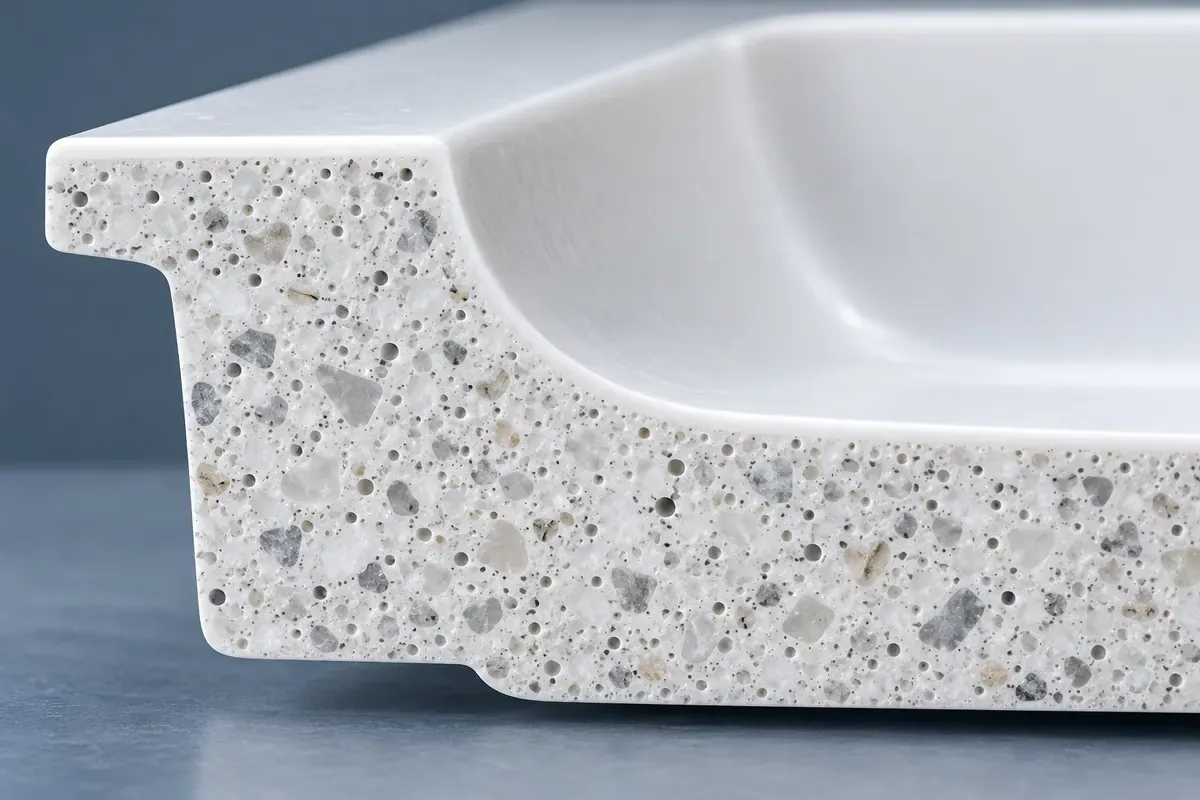
In this guide, the term means a cavity observed in a cut section of the cured article. It does not prove that the cavity formed during polymerization. Air could have entered earlier; a cavity might also become apparent only when grinding removes a thin covering layer. Record the observation separately from the proposed mechanism.
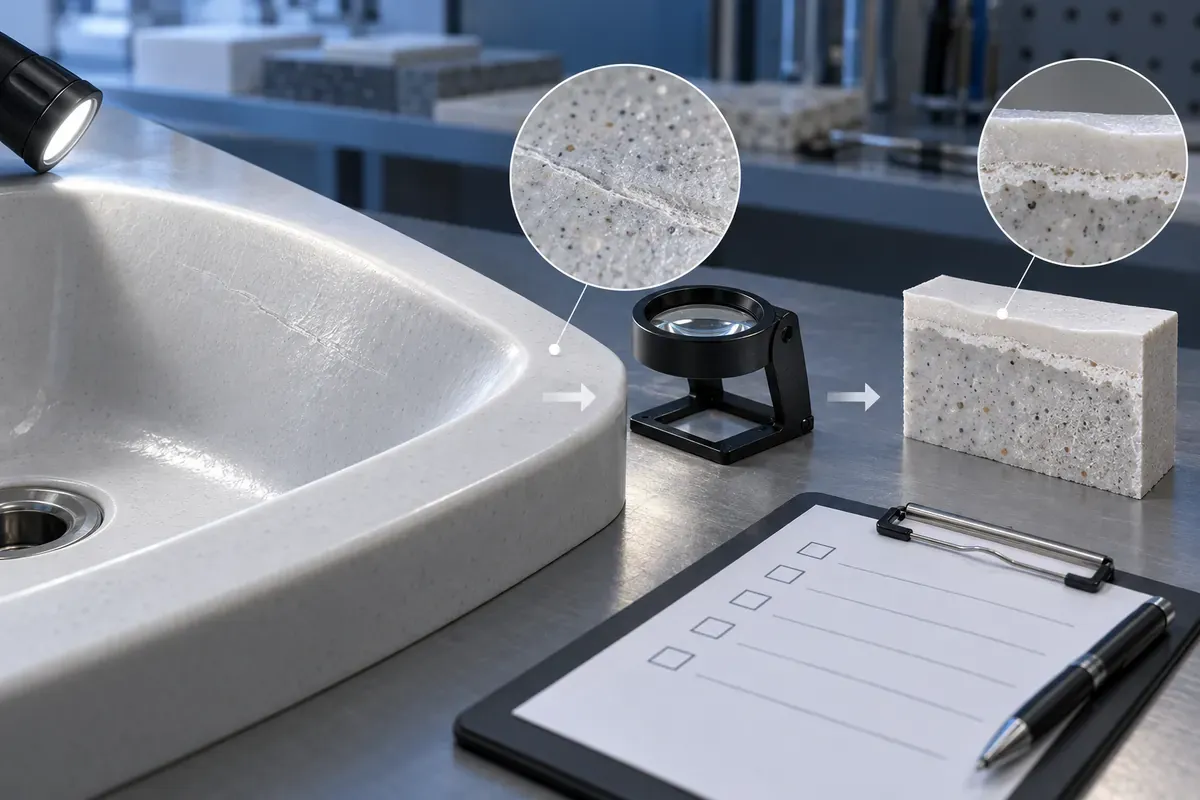
Keep a failed sink and a matched acceptable sink before changing the formulation. Mark mold orientation, visible face, reverse side, inlet, vent, drain and machining depth. Use the same cutting and imaging procedure on both. Record any damage that section preparation itself could create.
Classify the evidence before choosing a remedy
The table is a proposed investigation aid. Its candidate mechanisms are hypotheses to test, not a claim that appearance alone identifies the cause.
| Observed pattern | Candidate explanation | Discriminating check |
|---|---|---|
| Rounded cavities distributed through a wall | Entrained air or gas evolution | Compare pre-fill mixture condition, degassing record and internal cure-temperature trace |
| Cavities concentrated in thick features | Local thermal or shrinkage-related behavior | Match section thickness with local temperature and defect distribution |
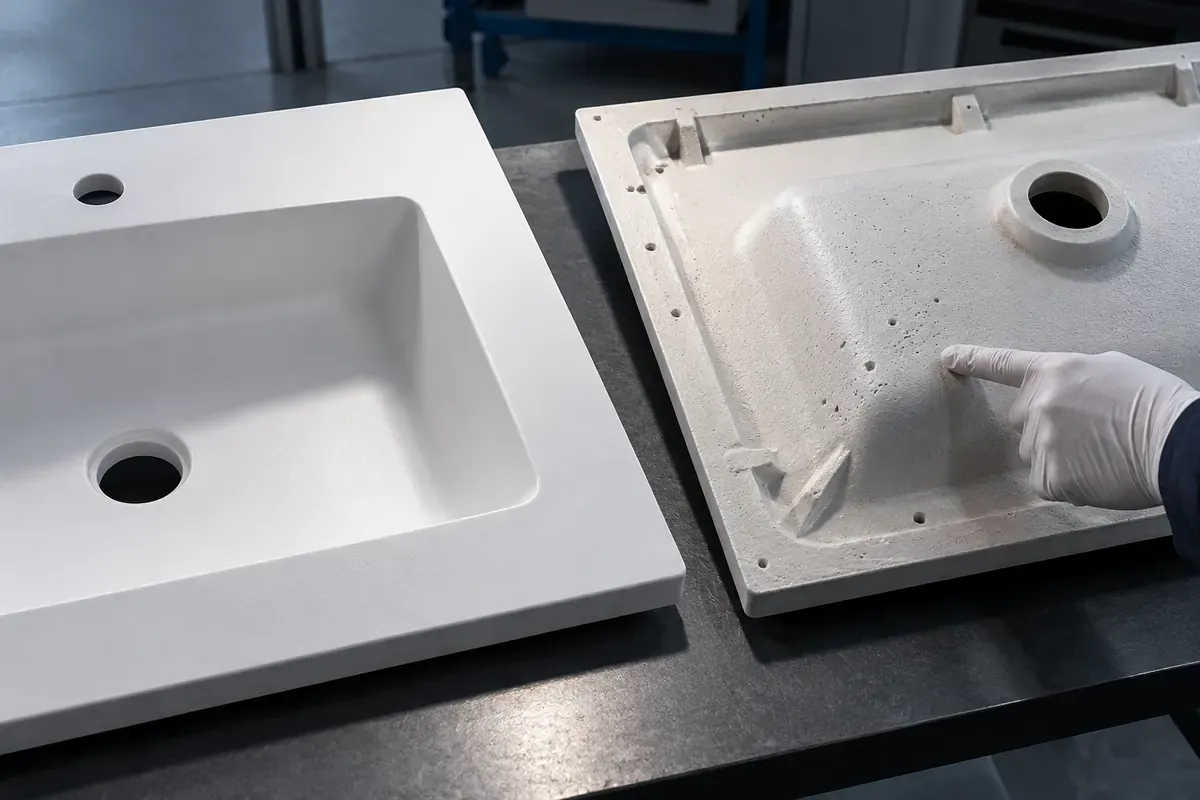
| Rough reverse side or drain-seat irregularity | Segregation, filling or local mold-interface effects | Inspect through-thickness filler distribution and repeatable geometric locations |
| Visible-face pinholes or isolated pits | Air at the mold interface, contamination or exposed subsurface cavities | Compare as-demolded and identically finished surfaces |
| Soft or tacky exposed layer | Local cure, formulation or oxygen-exposure effects | Check cure evidence; do not classify softness as porosity |
What sink-specific evidence actually says
Blanco's patent US7420016B2 discusses MMA-based sanitaryware compositions and distinguishes fine cristobalite powder from coarse fillers intentionally settling toward the visible side. Its background describes uneven reverse sides and rough or bubbled drainage holes in some thick-wall arrangements, including potential difficulties at outlet fittings. This is relevant because it treats the two faces and drain region separately. It does not establish that cristobalite inevitably produces voids, or that the patent's formulation is a universal remedy. [1]
A separate sink patent, EP0393129A1, concerns an ATH-filled PMMA system, not cristobalite-filled material. It discusses mold closure accommodating cure shrinkage and pressure sufficient to reduce gas-bubble formation. It supports considering tooling and cure together, but its pressure and formulation cannot be transferred directly to another resin, filler or mold. [2]
These documents are primary accounts of particular inventions. Their examples and claimed benefits are not independent comparative trials, current design standards or evidence of Changtong customer performance.
Follow the part backward through the process
At machining: was the cavity present under an intact skin?
Photograph the drain seat before and after material removal. Compare machining depth, tool condition and location across good and failed parts. A defect exposed by machining is different from a freshly chipped edge. Retain both the removed region and an adjacent unmachined section where practical. Never assume that a cosmetically acceptable surface guarantees a sound sealing land underneath.
At cure: what did the material temperature do?
Record actual temperature versus time in representative thick and thin regions, not only the heater setting. Wiley's polymer-casting guidance identifies formulation, entrapped or internally generated bubbles, heat transfer, cure rate, shrinkage and mold adhesion as coupled controls in monomeric systems such as PMMA. That is a process framework, not a prescribed sink cycle. [3]
For investigation, compare the onset and peak of the temperature trace with cavity location. A hotter thick section suggests a testable thermal hypothesis; it does not prove monomer boiling. Pressure, composition and local conditions matter. Ask the resin supplier to review the cure window before altering initiator, mold temperature or cycle time. Do not publish a universal “safe exotherm” for every acrylic compound.
At filling: does the pattern follow the mold?
Log fill direction, delay after mixing, filling duration, mold orientation and vent condition. Defects repeating at the same high point, corner or last-filled region justify checking the flow path before replacing the mineral. Compare matched parts rather than relying on a successful flat coupon: a sink includes changing thickness, a drain feature and an extended filling path.
At mixing: can the air and wetting history be reproduced?
Record addition order, mixing speed and duration, batch temperature, viscosity method and the time between mixing and casting. Document actual degassing conditions and any visible foaming or material loss. More vacuum or longer treatment is not automatically better for an MMA-containing mixture. Use equipment, ventilation and operating procedures approved for the resin and initiator system.
When the cristobalite grade deserves closer examination
Check the retained powder against the purchase specification and an accepted reference lot. Useful records include complete particle-size distribution, coarse residue, moisture method, apparent agglomeration, treatment identity and packaging history. Keep powder moisture distinct from assumptions about gas generation: a changed moisture result is evidence to investigate, not proof of the void mechanism.
Request a documented dispersion trial in the actual acrylic syrup. A fine grade can behave differently from a coarse blend, but neither “finer” nor “lower viscosity” is a universal cure for defects. The relevant question is whether the selected grade can be wetted, mixed, filled and cured within the validated production window.
If surface treatment is involved, verify its compatibility with the methacrylate formulation instead of borrowing an epoxy recommendation. Do not change the treatment, particle distribution and resin formulation simultaneously; a passing part after three changes will not identify which change mattered.
Use a staged trial, with a pass rule agreed beforehand
First reproduce the accepted reference using the retained good filler and current process. Then compare the candidate filler while holding the remaining formulation and process constant. Preserve repeat runs and record exceptions. Only after this comparison should a controlled process adjustment be assessed with the resin and equipment specialists.
Choose inspection locations in advance: visible bowl face, underside, thick transitions and drain sealing land. Define the inspected area or section length, minimum reportable defect size, finishing method and acceptance criteria. Otherwise, one trial may appear superior merely because it was cut in a different place or polished more heavily.
Evaluate relevant finished-part requirements separately, including sealing, dimensional behavior and customer-defined mechanical or thermal tests. A reduction in visible pinholes does not by itself demonstrate long-term durability or a leak-free drain assembly.
Frequently asked questions
Does a tacky underside prove that cristobalite inhibited cure?
No. Check formulation, local temperature, exposure and cure evidence. An original PMMA/glass-fiber study examined oxygen-inhibited surface polymerization, but that dental composite is not a sink system. It supports a mechanism worth checking, not direct diagnosis of cristobalite-filled sanitaryware. [4]
Will changing filler remove every internal cavity?
No such guarantee follows from the evidence. A material comparison should accompany, not replace, checks of mixing, filling, tooling and cure.
Should every rough underside be rejected?
Use the drawing and agreed acceptance standard. Cosmetic texture, drain sealing quality and structural cavities are different requirements. A rough region affecting a seal needs specific evaluation even if it is not normally visible.
Send a diagnostic RFQ, not only a whiteness target
When evaluating cristobalite powder for acrylic mineral-cast sanitaryware, describe the resin/syrup family, loading, required particle-size distribution, mold arrangement and observed defect locations. Include representative section photographs and a non-confidential process summary. For a neighboring composite-process perspective, see our guide to quartz-filler wet-out, settling and finish; it is not a substitute for an acrylic sink trial. Application suitability must be established in your own process.