Price the Accepted Slab, Not Just the Filler Tonne
Compare filler trials for low-crystalline-silica slab development by total cost per accepted area, while keeping phase evidence and slab qualification as separate gates.

PROCUREMENT · TRIAL ECONOMICS
A filler quote arrives in dollars per tonne. A slab plant earns revenue from saleable area. The useful comparison lies between those units: how much qualified, accepted slab area did a trial produce for the full cost it consumed?
That question changes what purchasing records. A low price per tonne can be outweighed by extra resin, longer processing, rejects, rework, or more inspection. A higher quote can still be uneconomic if it reduces accepted output or misses a customer requirement. Until a trial measures those effects, the answer is a hypothesis—not a supplier claim.
For a zero-crystalline-silica transition project, keep three approval gates separate: phase evidence for the incoming material, finished-slab qualification against the target specification, and economics per accepted area. A product name or the word “amorphous” does not quantify crystalline phases in a purchased lot or cured composite. The supplied reports include no XRD result, so they cannot substantiate a zero-crystalline claim. Request traceable phase analysis for the material and product basis you intend to qualify; assess workplace dust exposure separately from composition and trial cost.

Start with a denominator the plant recognizes
For a controlled comparison, define the trial boundary before loading the mixer. A practical headline measure is:
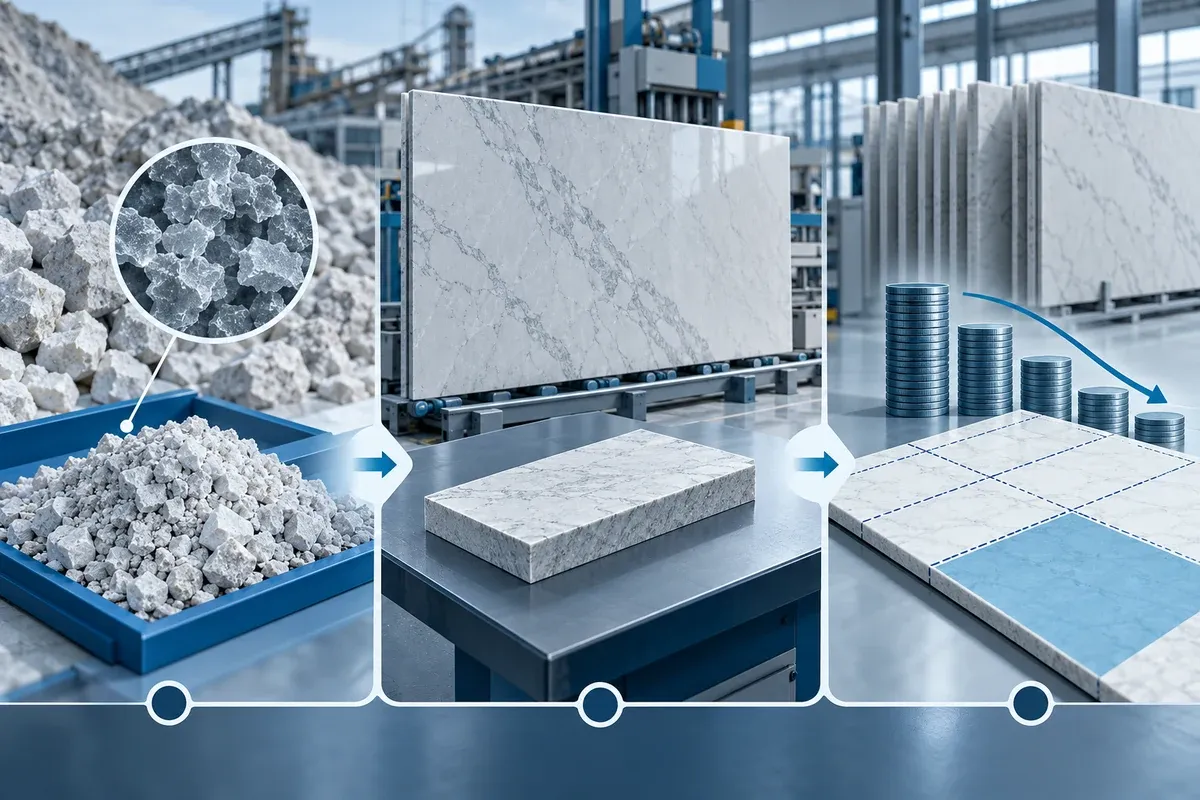
Trial cost per accepted square metre = attributable trial cost ÷ accepted slab area
“Attributable trial cost” should be consistent across options. Include the filler actually consumed, resin and other ingredients, direct processing time, quality checks, rework, and disposal if those are in scope. Record what is excluded. “Accepted area” must use the customer's agreed inspection criteria; gross cast area is not a substitute. If thickness or format varies, compare like with like or normalize the area to an agreed specification.

Use measured slab mass carefully
An anonymized R&D report lists apparent density of 2.21 g/cm³ for a finished fused-glass slab sample. That is a slab result, not a filler density or recipe share. For scale only, if a hypothetical finished slab were 20 mm thick and uniform at that density, one square metre would weigh about 44.2 kg: 2,210 kg/m³ × 0.020 m. This estimates finished-product mass only; it does not reveal filler kilograms per square metre or a transferable recipe.
Keep the mass balance explicit: weigh each ingredient, record trim and rejects, then reconcile input against saleable output and process loss. Do not infer a sample-specific recipe from density; any percentage needs a clear basis before comparison.
Treat filler function and yield as testable hypotheses
Powder and sand can play different roles in a resin-bound slab, depending on grading, surface characteristics, resin system, and processing. A powder may affect packing, paste demand, or surface appearance; a coarser fraction may alter bulk structure or exposed texture. These are possible mechanisms to investigate, not guaranteed outcomes. A change that helps one property may raise resin demand, complicate finishing, or alter color consistency. Track customer-facing quality measures alongside cost so that low-cost area is not counted as accepted when it misses specification.
For a trial, hold slab design, thickness, resin system, process settings, cure, and inspection criteria as steady as practicable. Change one material variable at a time where feasible. Use replicate batches if production variability matters. A trial request can specify product, finish, particle role, tests, visual acceptance, sample mass, packaging, and traceability. Discuss fused glass powder for engineered-stone slabs separately from fused glass sand for engineered-stone slabs; particle role belongs in the trial brief.
A purchase decision needs a stop rule
Before the trial, set scale-up limits for accepted yield, cost per accepted area, required quality results, and repeat lots. Define a stop rule for failures or unstable measurements. If results remain uncertain, run another controlled batch before forecasting savings.
Questions buyers ask
Can slab density be used to calculate filler consumption?
No. Finished-slab density includes the whole composite. It cannot isolate filler mass without a verified formulation and a batch mass balance.
Should a trial be judged by cost per tonne?
Use price per tonne for the purchase line, then compare total attributable cost per accepted area under the same quality criteria. The measures answer different questions.
What should the RFQ include?
State target slab, finish, thickness, particle role, qualification tests, sampling and lot requirements, packaging, and required trial records. Define acceptance and stop rules before production.
Build a comparable trial. Share your target slab specification, evaluation plan, estimated trial quantity, and required records through our contact page to scope a sample against plant economics and acceptance criteria.
Related products
Related technical guides
Request a quote for your slab filler trial
Share your target grading, resin system, intended use and evaluation requirements to prepare a focused request for quote.
Request a quote