Quartz Filler in GFRP Floor Panels: Separating Wear Performance from Interlaminar Failure
A practical qualification guide separating a floor panel's abrasion behavior from interlayer-sensitive mechanical performance, process consistency and finished-panel requirements.
Technical application guide · Materials: natural-quartz-derived crystalline silica filler · Application: glass-fiber-reinforced polymer floor panels · Audience: formulation, production and quality teams
Scope: a qualification framework, not a validated floor-panel formulation or a Changtong performance claim.
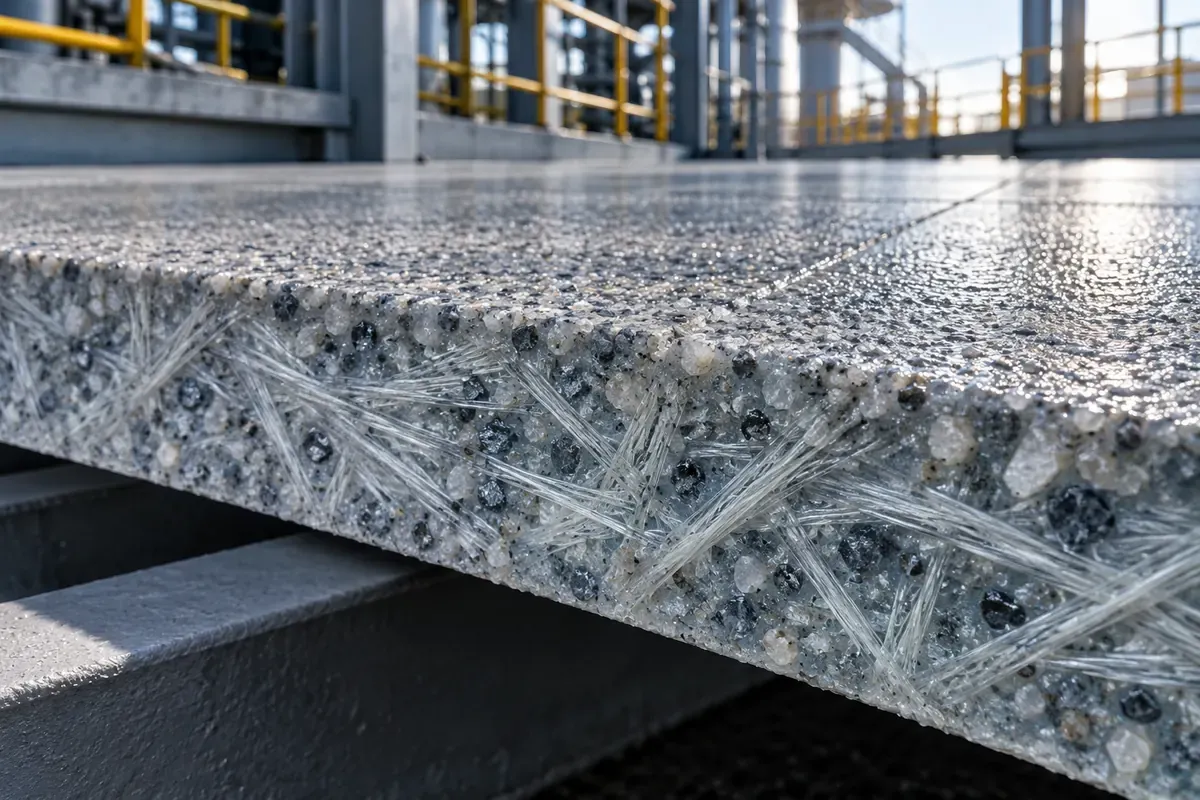
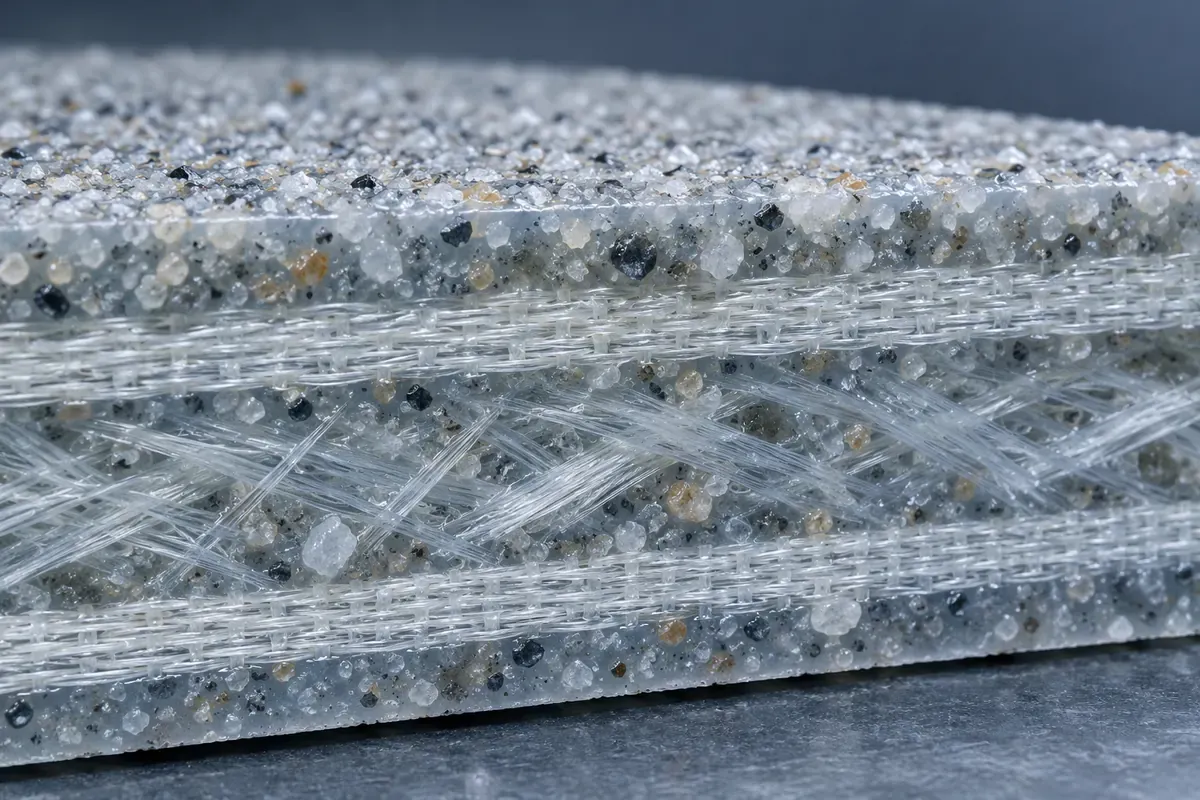
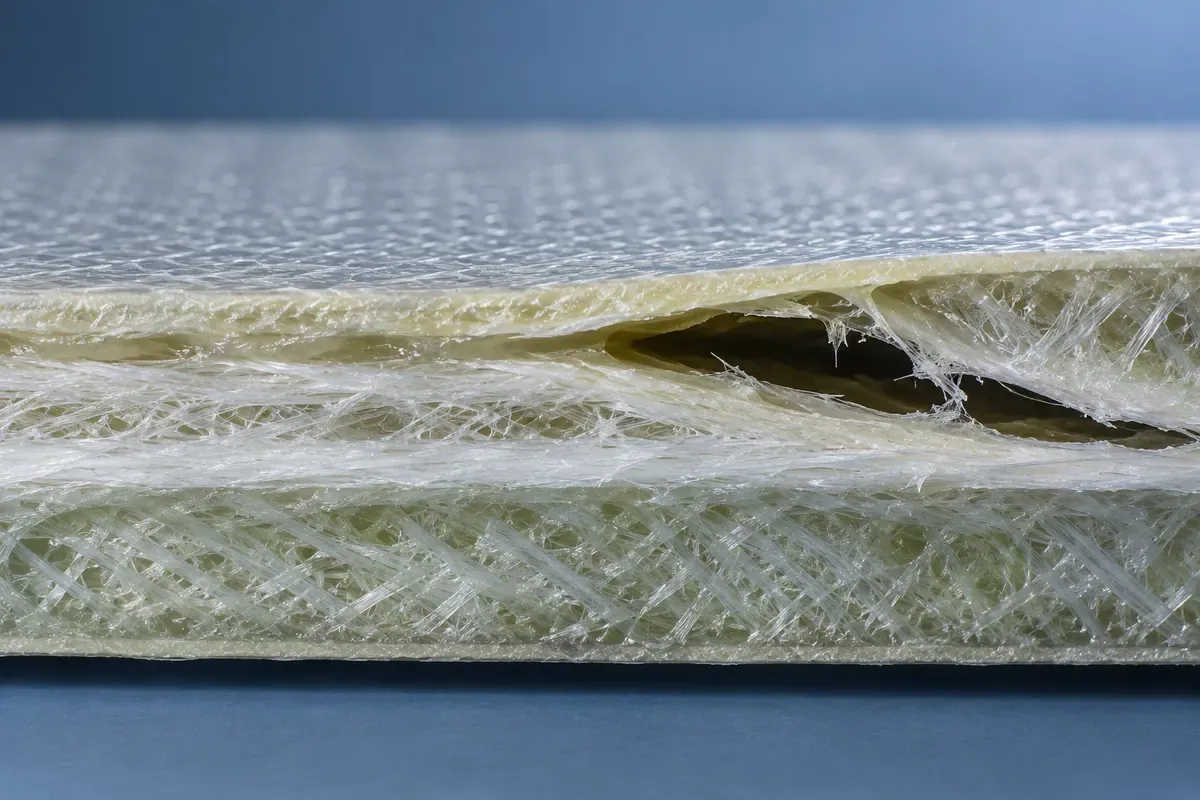
A floor-panel coupon can retain a tidy wear surface while a crack opens between its glass-fiber layers. Neither observation cancels the other. The surface is resisting one loading mechanism; the laminate is failing under another. Approving quartz filler from an abrasion ranking alone leaves that distinction unresolved.
For a quartz-filled GFRP floor panel, the purchasing question is therefore not simply which powder makes the surface harder. It is whether a specified powder, loading and manufacturing process can meet both the surface-wear requirement and the laminate's structural acceptance criteria. Those decisions need separate evidence, followed by a check on the actual panel construction.
Two claims that need separate proof
Wear performance describes the response of a surface in a defined contact system. Interlaminar failure describes damage between laminate layers. A test that removes surface material does not automatically interrogate the interfaces deeper in the panel. Likewise, a satisfactory bending result does not establish that a walking or cargo-contact surface will resist its intended abrasion.
The relevant contact might involve sliding cargo, tracked grit, cleaning or repeated movement across panel joints. Establish which mechanism the laboratory test represents. Keep slip resistance, fire behavior, chemical resistance, concentrated loads and fastening performance as separate requirements where the panel specification calls for them. They are not demonstrated by a quartz certificate or by an abrasion result.
What the quartz-filled GFRP research actually establishes
A 2021 study examined quartz-filled glass-fiber polymer composites intended for floor panels. Its wear ranking did not provide a universal ranking for shear or impact performance. A wear improvement in one tested construction did not translate into matching improvements across the other measured properties. The useful lesson is the need to qualify the combination of filler, reinforcement and matrix—not to copy a reported filler percentage into another laminate. [1]
A related 2023 study changed the binder form used in the glass mats and compared two epoxy matrices. It reported formulation-dependent responses rather than a simple relationship between more quartz, greater hardness and better wear performance. Here, “powder binder” and “emulsion binder” refer to the glass-mat binder; they should not be confused with the resin's curing agent. [2]
Neither paper qualifies Changtong material, establishes an optimum for every floor panel, or validates an alternative resin system. Treat the research as a reason to design a controlled trial. Differences in particle size, mat architecture, binder compatibility, cure and processing require their own evidence.
Build an evidence matrix before mixing
Agree on the failure limits before seeing the results. The following matrix separates observations that are often compressed into the phrase “better mechanical properties.” It is a planning aid, not a mandatory test schedule.
| Decision | Evidence to collect | Critical comparison control | Do not conclude |
|---|---|---|---|
| Does the surface resist the target contact? | Applicable wear result, surface condition and damage depth | Counterface, load, motion, conditioning and debris handling | The laminate cannot delaminate |
| Are interlayer-sensitive results acceptable? | Suitable mechanical test plus documented failure mode | Stacking sequence, thickness, geometry and specimen orientation | A short-beam number is a pure interface property |
| Was the laminate made consistently? | Sections, thickness map and process records | Sampling position, cure, consolidation and preparation | Every weak specimen proves a powder defect |
| Does the panel survive its service conditions? | Customer-specified conditioned and panel-level tests | Support, joints, fasteners, exposure and loading | Coupon approval certifies the installed floor |
Audit the test before accepting the ranking
Wear: check the metric and what was removed
Keep the original units and definition. A metric expressing energy per mass removed is not interchangeable with volume lost per load-distance. “Higher is better” must follow the metric, not its informal label. Record whether the test exposes a surface coat, resin-rich layer, quartz particles or glass reinforcement as it proceeds.
ASTM D4060 covers organic coatings on a plane, rigid surface; its suitability for a particular floor-panel surface must be established rather than assumed. Its guidance notes that dense fillers can alter the relationship between mass loss and thickness loss, and that debris and wheel condition affect comparisons. Where relevant, supplement a mass-based result with an agreed thickness or profile measurement. [3]
Interlaminar response: retain the failure description
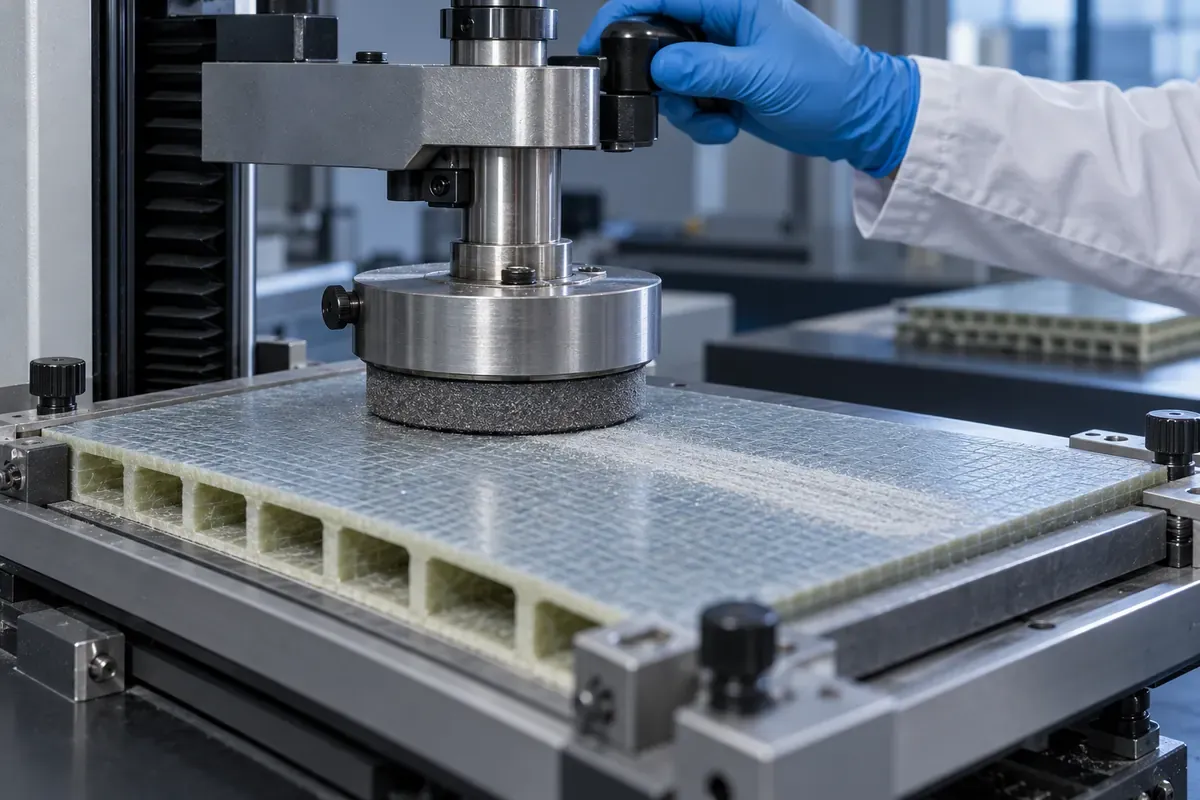
ASTM D2344/D2344M describes short-beam strength, not an isolated, universally transferable interlaminar material constant. The standard explains that complex stresses and different failure modes limit that interpretation; comparative testing requires consistent failure modes. Have the laboratory confirm applicability to the actual laminate, including its geometry and reinforcement arrangement. [4]
A result sheet should retain fracture photographs and the laboratory's failure classification. A value produced by indentation, crushing or a changed fracture mode should not silently be ranked alongside results governed by a different mechanism. Investigate the difference before attributing it to particle chemistry.
Run a filler trial that can explain a failure
Start with the accepted panel construction as the reference. Identify whether quartz belongs in the exposed surface layer, the structural laminate, or both. Changing those locations simultaneously makes a favorable wear result difficult to separate from an unfavorable structural change.
In the first screening series, hold the resin and hardener, glass grade, mat binder, reinforcement mass, stacking sequence, nominal thickness and cure schedule constant. State the filler-loading denominator. Record actual constituent quantities so that adding powder does not hide a reduction in glass content or a change in resin available for impregnation.
Before cure, record mixing temperature, elapsed time, wet-out observations and consolidation. After cure, inspect representative sections for local particle accumulation, visible voids, resin-rich regions and incomplete impregnation. These are diagnostic observations, not proof of a unique root cause. Preserve failed coupons and compare their locations with the panel's thickness and process records.
If wear improves but interlayer-sensitive performance deteriorates, do not average the two into a pass. First check whether laminate architecture or manufacturing consistency changed. Then plan a limited follow-up around the suspected variable. A separate surface-layer formulation may be worth evaluating, but it remains a new construction requiring qualification.
Keep three approval gates open
First, release the material trial only when the incoming powder and manufacturing records are interpretable. Second, require the agreed surface and laminate results to pass independently. Third, confirm that the selected construction performs at panel scale under the customer's support and loading conditions. A favorable average must not conceal a local failure or a result outside the approved test scope.
This last gate matters when a floor has joints, cutouts, fasteners, bonded skins or a sandwich core. A small coupon does not reproduce all those details. Select panel-level evaluations with the designer and laboratory; do not assume a laminate short-beam method characterizes a skin-to-core bond or a fastening zone. If exposure to moisture, temperature or cleaning agents is relevant, define conditioning and retest requirements before approving the construction.
During pilot production, retain the selected powder lot and the actual processing window as part of the approval record. A later change to glass mat, surface-layer thickness or cure can require review even when the powder certificate has not changed.
Specify the powder without promising the panel
For natural quartz powder for glass-fiber composite floor-panel trials, request the grade-specific chemistry, particle-size distribution in μm with its method, oversize control, moisture evidence, treatment status and batch documentation. Confirm which values are release limits and which are reference information. Quartz powder is a particulate filler; it is not glass-fiber reinforcement or fumed silica.
Our guide to quartz-filler wet-out, settling and finish in polyester composites addresses related processing questions, but it does not qualify the same resin chemistry or laminate structure. Send the actual floor-panel construction, contact conditions, test methods and rejection criteria before requesting a trial grade.
Frequently asked questions
Does harder quartz automatically make a more wear-resistant floor?
No. Powder hardness alone does not define the contact system, retention of particles, surface construction or laminate integrity. Test the intended surface.
Can the best published quartz percentage become our starting specification?
Use it only as research context. A contractual formulation requires trials with your resin, reinforcement, powder and process—not a transferred optimum.
Does a short-beam pass prove resistance to all delamination?
No. It is evidence within the method's scope and observed failure mode. Service-specific loads, conditioning and the finished panel need separate consideration.