Residual Quartz in Fired Silica Castables: What Buyers Should Verify
Review residual quartz in fired silica castables with published firing comparisons, XRD reporting boundaries and separate dimensional and strength records.
Industrial Application Guides · Technical review · First published · Updated
A raw-powder certificate cannot establish the phase composition of a fired refractory component. For a quartz-based castable designed to mineralize during firing, purchasing teams need a paired record: the incoming materials and the processed body. A residual-quartz result becomes useful only when the firing history and analysis basis travel with it.
A published comparison with a defined formulation
Chen and colleagues investigated quartz-based castables with 3, 4 and 5 wt% calcium silicate cement, labelled C3, C4 and C5. The mixtures contained 8 wt% microsilica. Their Table 3 reports the following relative crystalline quartz values after 20-hour firing holds.
| Batch | Cement (wt%) | 1400°C: quartz (%) | 1430°C: quartz (%) |
|---|---|---|---|
| C3 | 3 | 13 | 10 |
| C4 | 4 | 7 | 6 |
| C5 | 5 | 8 | 1 |
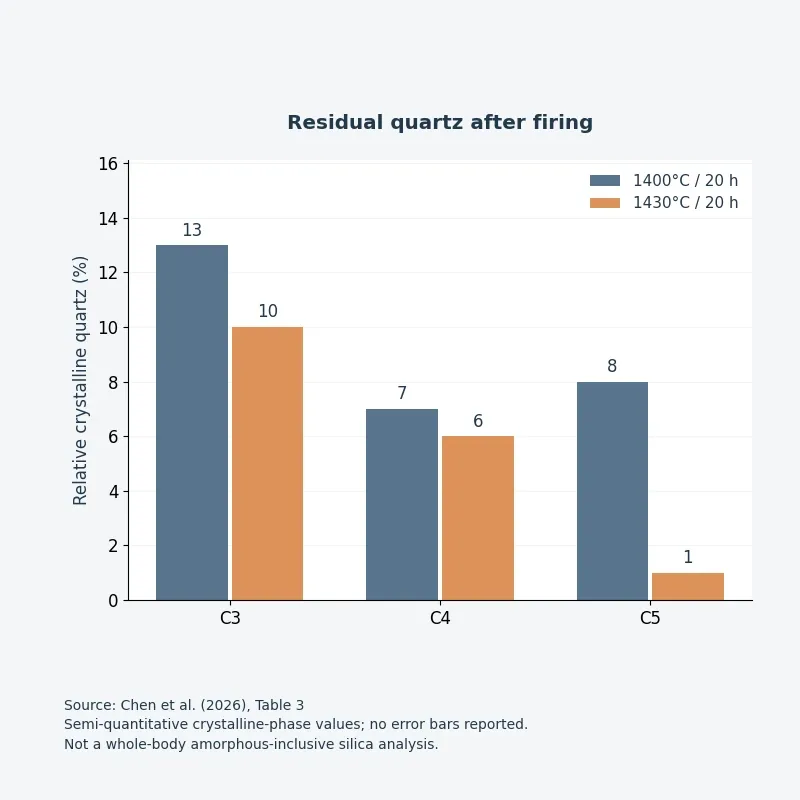
The table reports 1% for C5 at 1430°C. Other parts of the paper use “less than 1%”; this guide retains the tabulated value. The table and narrative also differ for some phase fractions, so no reconstructed stacked phase chart is presented.
Read phase change alongside dimensional change
A small residual-quartz value is not an independent acceptance certificate. It does not answer whether the fired component meets the buyer's geometry, strength, loading or service requirements.
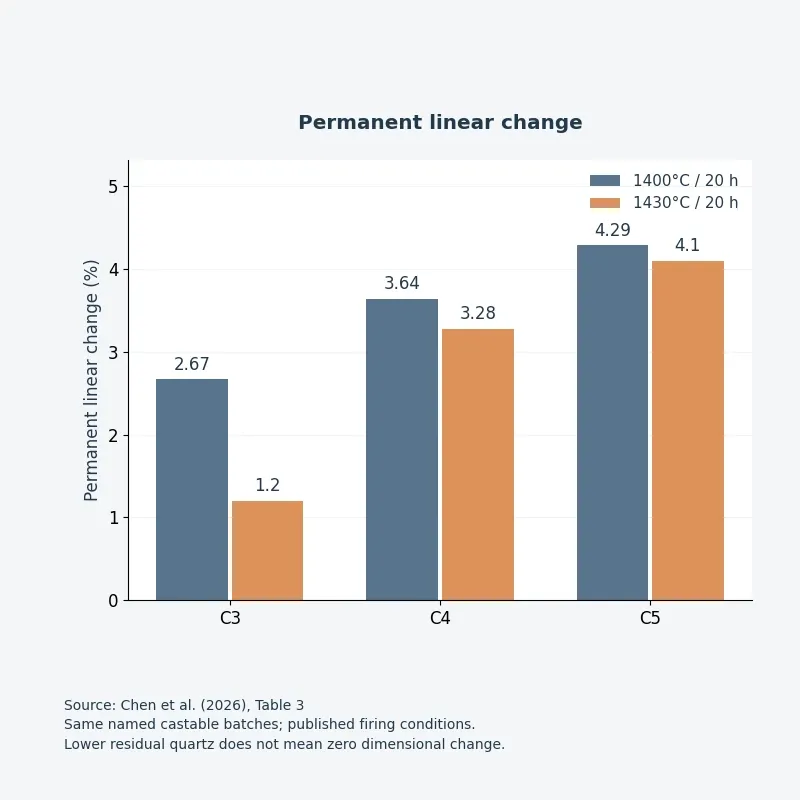
For procurement, agree when dimensions are recorded, which reference length is used and whether the reported change belongs to an unrestrained coupon or a finished shape. These are different acceptance situations. Set limits from the component design and validated trials rather than borrowing a literature value as a universal threshold.
Keep pre-firing strength in its own record
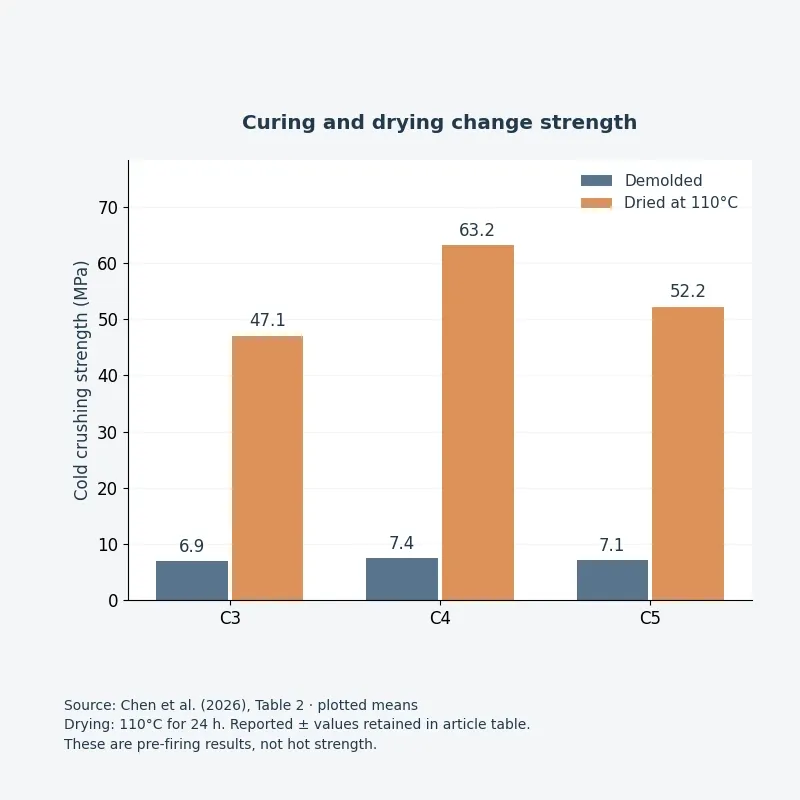
| Batch | Demolded CCS (MPa) | 110°C / 24 h dried CCS (MPa) |
|---|---|---|
| C3 | 6.9 ± 0.1 | 47.1 ± 3.0 |
| C4 | 7.4 ± 0.1 | 63.2 ± 0.3 |
| C5 | 7.1 ± 0.1 | 52.2 ± 0.6 |
The ± values are reproduced as reported; no new confidence intervals are calculated. A receiving team should avoid combining a dried-strength report and a fired-phase report as though they describe one test state.
A fired-phase acceptance record
| Record | Buyer question | Decision boundary |
|---|---|---|
| Material route | Is the mix intended to mineralize crystalline quartz? | Do not transfer this route to a fused-silica system intended to retain an amorphous phase. |
| Sample location | Does the sample represent matrix, coarse aggregate and the relevant component position? | A favourable small coupon does not prove a large shape is uniform. |
| Firing history | What ramps, holds, load arrangement and cooling history were used? | A nominal peak temperature alone is insufficient. |
| XRD analysis | Are phase values relative to crystalline phases, and how are preparation and fitting reported? | Clarify detection, quantification and any amorphous treatment before setting a limit. |
| Component validation | Are dimensions, mechanical tests and service-relevant checks acceptable? | Phase acceptance does not replace finished-component qualification. |
Specify the intended silica route before requesting a grade
Ground crystalline quartz, surface-treated quartz, fused silica and cristobalite require separate identity records. The microsilica addition in the cited castable is a separate ingredient and must not be relabelled as natural ground quartz powder.
Buyers considering a different, fused-silica route can review Fused Silica Powder for Refractory Castables and the existing thermal-cycling crack investigation guide. Those pages address a different selection question; the mineralized-quartz data above do not predict their performance.
Evidence boundary: Published results are industry references, not Changtong measurements or product guarantees.
FAQ
Can incoming SiO₂ purity stand in for residual quartz after firing?
No. Chemistry and fired phase identity answer different questions. Retain both records.
Should every buyer specify 1% residual quartz?
No. This is one published formulation and analysis basis. A purchase limit needs an agreed method, representative sampling and a component-specific validation plan.
Can we copy the published furnace schedule?
Use it as a research reference. Production settings require validation for the full recipe, component scale and furnace loading.
Prepare a focused RFQ
Send the intended silica route, complete binder and additive system, proposed firing history, finished geometry, sampling plan and required phase-analysis basis. Ask which current grade documents and samples are available for the defined trial.
Reference and evidence scope
Chen, Z. et al. “Quartz-Based Castables with Calcium Silicate Cement as Binder-Mineralizer: Replacing Shaped Product for Large-Scale Fabrication.” High-Temperature Materials 3(1), 10006, March 25, 2026. DOI: 10.70322/htm.2026.10006. Open full text; Tables 2 and 3. Charts are original redrawings of tabulated data. The acceptance-record recommendations are editorial engineering guidance, not a quoted standard or a validated Changtong process.