How Changtong Uses COA, TDS, SDS and XRD for Grade Review
Learn how Changtong connects COA, TDS, SDS and XRD records into a grade and lot review process while keeping historical evidence within its documented scope.

A quality file is useful when each record answers the next approval question.
Changtong connects the product description, grade reference, lot result, safe-handling information and phase evidence in sequence. This article explains that evidence chain and its boundaries; it is not a repeat of a generic buyer document checklist.
Last updated:
From Material Request to Evidence Chain
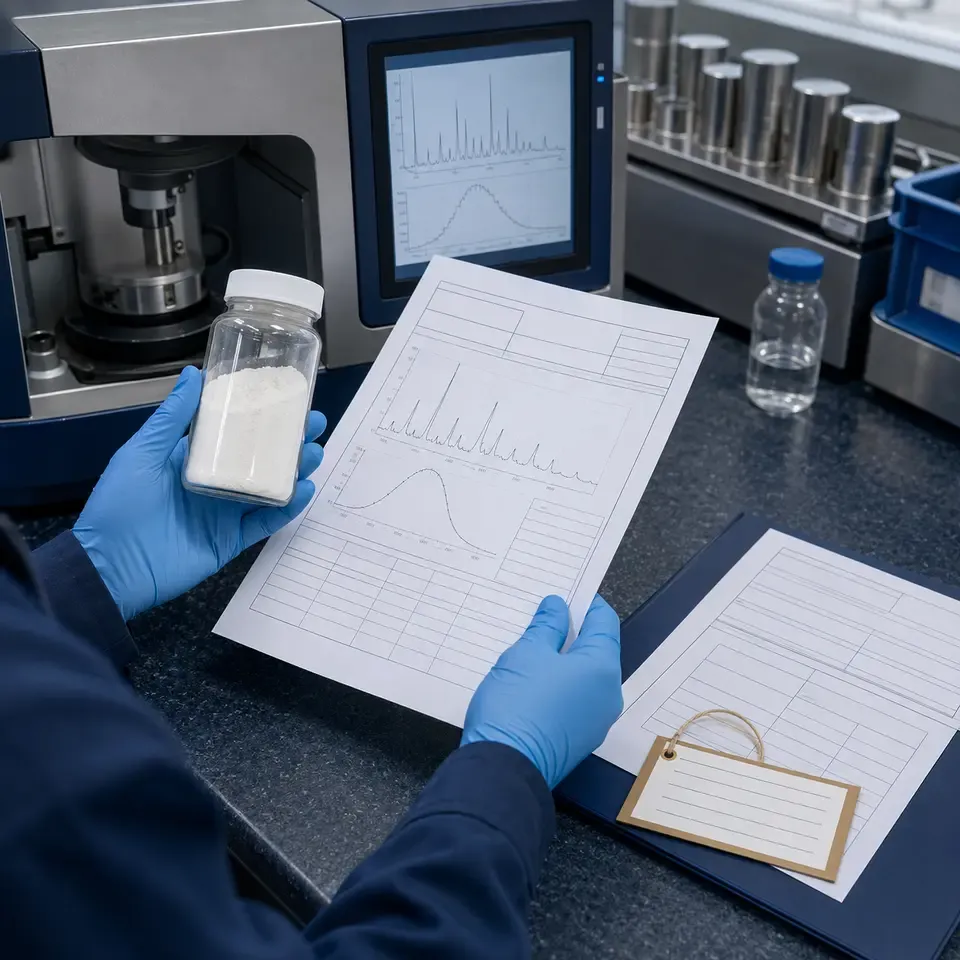
Changtong quality documentation is most useful when the records are read as a sequence rather than as isolated attachments. The request identifies the product and grade, the TDS defines the intended reference, the COA connects measured results to a named lot or sample, the SDS supports safe handling, and an XRD record can answer a phase question for the tested material.
| Review stage | Question answered | Record or action |
|---|---|---|
| Identity | What material family and grade are being discussed? | Quotation, sample label, product name and current TDS. |
| Reference | Which properties and intended use are described for the grade? | Grade data sheet or specification with revision and date. |
| Measurement | What was measured for the named sample or lot? | COA with units, methods, results, lot/sample scope and release status. |
| Safety | How should the dry material be handled in the applicable market? | Current SDS for the exact grade and destination market. |
| Phase or special evidence | What additional technical question needs support? | XRD or other defined report tied to the tested sample and test date. |
How the Four Main Records Work Together
TDS: establish the grade reference
The TDS provides the working description of a grade, such as intended application, chemistry or physical reference fields. It should be read as a controlled grade reference, not as proof that every shipment has identical measured results.
COA: connect results to the lot or sample
The COA is the record used to review reported results for a named grade and lot or sample scope. Units, methods, test date and release status matter as much as the numeric result.
SDS: keep handling information in scope
The SDS addresses hazards, handling, storage, cleanup, exposure control and PPE for the applicable product and market. It is not a substitute for a TDS or COA.
XRD: answer a defined phase question
An XRD report can support a phase or structure interpretation for the tested sample. Its conclusion must remain attached to the report date, sample identity and method scope.
What the Changtong Records Reviewed Here Show
| Record | Documented use in this article | Scope limitation |
|---|---|---|
| Fused silica COA, December 2025 | Shows how chemistry, physical and mesh/pass-range fields are presented for the named RG400/RG600 scope. | Use the current revision and exact lot or grade scope for a release decision. |
| Investment-casting grade sheet, December 2023 | Provides a grade-specific reference for investment-casting discussion. | It is not a substitute for a current lot COA. |
| Fused silica MSDS, March 2021 | Provides a dated handling and hazard reference for fused silica. | Confirm the current SDS for the destination market and exact grade. |
| Fused silica XRD report, test dated August 6, 2014 | Reports an “Amorphous State” conclusion for the identified 325F and 200F samples. | Historical sample evidence; it must not be presented as today's release result. |
| Cristobalite EU SDS, revision March 2020 | Identifies the documented M3000/G325 cristobalite flour context. | Historical EU-market revision; confirm current destination-market documents. |
How to Read a COA Without Overextending It
Start by matching the product name, grade and lot or sample identifier to the quotation, package label and purchase record. Then check the unit, method and result type. A nominal sieve reference is not the same as a laser-diffraction D-value, and a typical grade value is not automatically a guaranteed acceptance limit.
For example, the December 2025 fused silica COA lists 200 mesh as a 75 µm nominal opening and 325 mesh as a 45 µm nominal opening. These are sieve-reference values in that document; they do not establish D10, D50 or D90 unless a separate PSD method and result are reported.
Handling Document Differences
Differences between documents should be treated as a review event, not silently averaged. Check whether the documents refer to different grades, samples, dates, markets, methods or value types. If the difference remains material, the approval file should record the open question and request the current controlling document.
| Observed difference | First check | Next controlled action |
|---|---|---|
| Different product names | Compare grade, family and package label. | Hold the comparison until identity is aligned. |
| Different particle-size numbers | Compare sieve, retained-percentage and PSD methods. | Rewrite the requirement using the named method. |
| Different dates or revisions | Identify the current destination-market and grade document. | Use the current controlling revision and retain the old record as history. |
| Phase evidence from an old report | Check sample identity and test date. | Use it as historical support only; request current evidence when required. |
Document Handoff for a Technical Review
A clear handoff should state the grade under review, the buyer's application, the acceptance fields, the current document revisions and any historical evidence that is being used only for context. This makes it easier for technical sales, quality personnel and the buyer to discuss the same material scope.
Changtong's available documents can support a structured discussion, but final approval remains dependent on the current quotation, applicable TDS/SDS, lot COA and the buyer's own incoming or application checks.
Frequently Asked Questions
Why does Changtong separate TDS and COA?
The TDS describes a grade reference, while the COA reports measured results for a named sample or lot. They answer related but different approval questions.
Can an old XRD report be reused for every shipment?
No. It can explain the result for the identified historical sample, but it does not automatically prove the phase of a later lot.
Why should the SDS be checked by destination market?
Handling and hazard communication requirements can depend on the applicable market and document revision. The SDS should match the grade and destination context.
Related Changtong Products
Connect the document review to the exact grade. See Fused Silica Powder 325 Mesh and High-Whiteness Cristobalite Powder for Epoxy and Refractory Applications, then request the current TDS, SDS and lot-specific COA for the quoted product.
References
Request a Grade- and Lot-Matched Review
Share the application, quoted grade, document revisions, particle-size method and lot requirements so the technical file can be reviewed within the correct scope.
Contact Changtong technical sales