Cristobalite Dental Investments: Why Water/Powder Ratio Changes the Trial
Evaluate cristobalite dental investments through water/powder ratio, matched mixing records, thermal expansion and casting dimensions, with published evidence boundaries.
Industrial application guide · Technical review ·
Cristobalite Dental Investments: Why Water/Powder Ratio Changes the Trial
A dental investment buyer needs dimensional consistency after mixing and burnout. Cristobalite content alone cannot define that result. The useful purchasing question is whether a candidate powder gives repeatable performance inside the selected binder, water/powder ratio and mold-heating procedure.
What the published evidence establishes
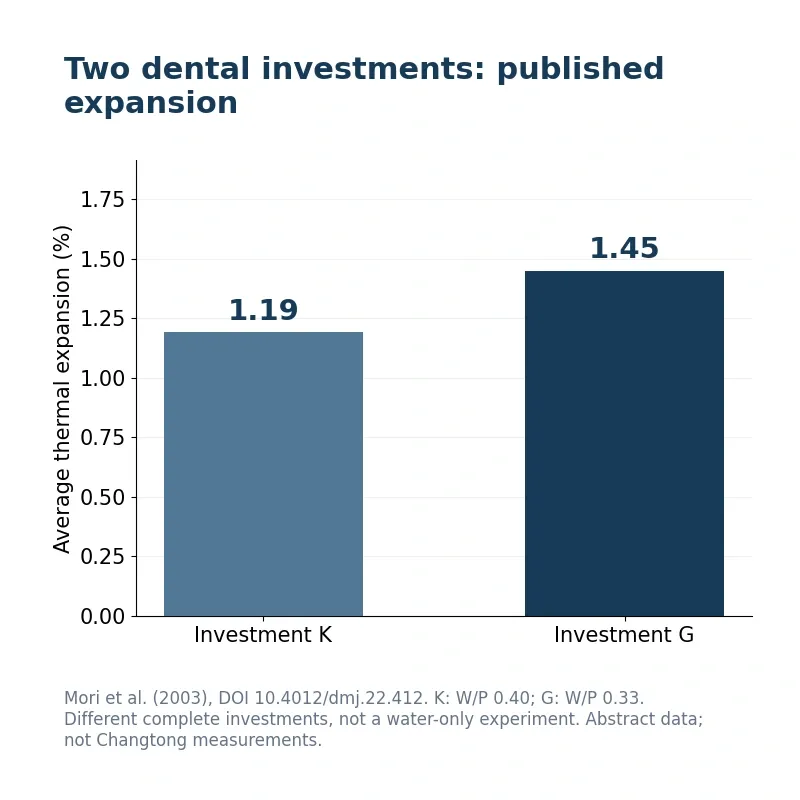
Mori, McAloon and Aghajani compared two gypsum-bonded investments with nearly identical nominal proportions: 70% cristobalite refractory and 30% binder. Their recommended water/powder ratios were 0.40 for K and 0.33 for G; average thermal expansion was 1.19% and 1.45%, respectively. These are two commercial investment systems, not a controlled experiment in which only water content changed. The authors also discussed gypsum dehydration and recrystallization as a reason actual mold expansion may differ from an ordinary laboratory measurement. [1]
Separate the powder specification from the investment recipe
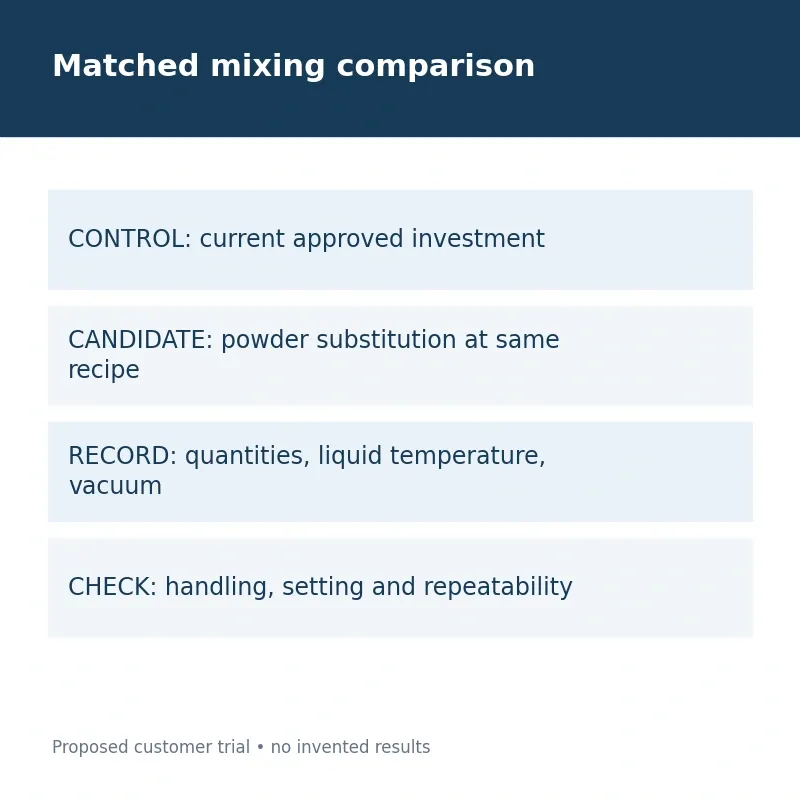
The powder supplier should identify crystalline phase, grading, moisture and lot traceability. The investment developer owns binder selection and the validated mixing instructions. A powder substitution should therefore begin with the current investment as the control. Retain its approved ratio before examining any formulation change. Record whether the ratio is mass-based or follows another documented convention; do not silently convert it into a universal milliliter-per-gram recipe.
Use paired mixing records, not a single expansion number
Prepare control and candidate batches using the same equipment, operator procedure and environmental conditions. Record powder and liquid quantities, liquid temperature, mixing and vacuum times, elapsed time to testing, and the relevant setting behavior. If a candidate needs more water for handling, treat that as a formulation change requiring renewed evaluation. A convenient slurry does not by itself demonstrate acceptable casting dimensions.
Connect laboratory expansion with the actual mold
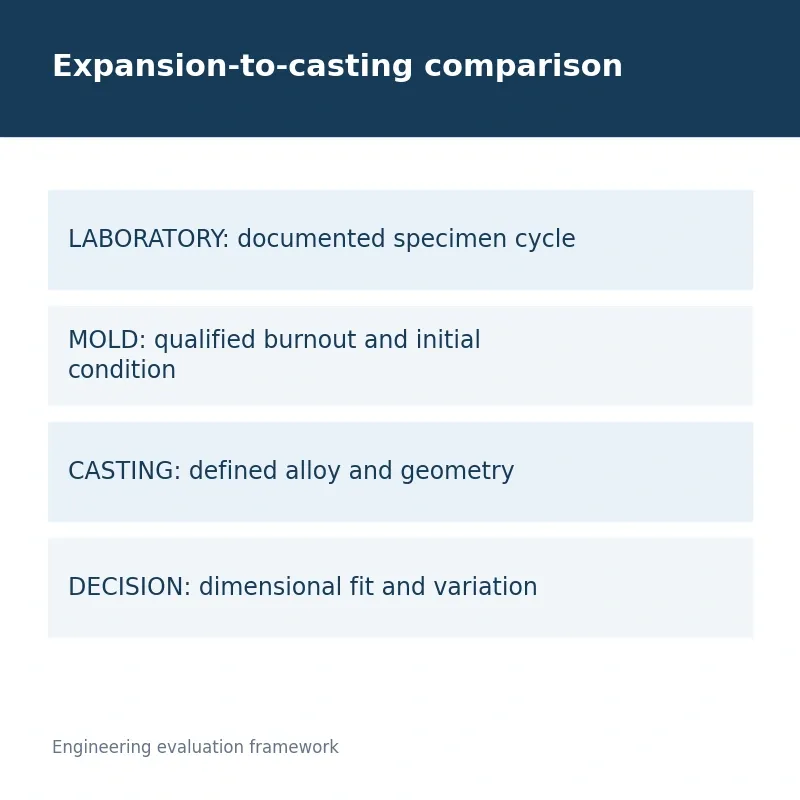
Compare the same investment under the laboratory expansion program and the customer’s qualified mold process. Record specimen geometry, initial condition, heating and cooling history, and whether setting expansion is reported separately from thermal expansion. Assess the resulting casting dimensions against the intended alloy and geometry. A difference between laboratory and mold results should trigger a process review before the cristobalite lot is blamed.
| Comparison | Record to retain | Decision use |
|---|---|---|
| Mixing | Ratio convention, liquid temperature and mixing history | Prevent an undocumented recipe change |
| Expansion | Specimen condition, cycle and length-change definition | Compare like-for-like measurements |
| Casting fit | Alloy, mold geometry and dimensional measurement | Validate the actual application |
Agree acceptance criteria before requesting trial powder
Define the dimension being controlled, permissible variation, reference formulation and required documentation before selecting a grade. Keep the trial result linked to a retained powder sample and its batch record. This allows a failed casting to be traced to powder, mixing or heating changes rather than reduced to a vague request for higher expansion.
Evidence boundary: Published research is an industry reference, not Changtong test data or a product guarantee. Foundation reference. Publisher abstract reviewed; detailed full-paper test conditions have not been used to prescribe a production process.
Frequently asked questions
Does the lower ratio prove higher expansion?
No. K and G were different investment systems. Their paired results do not isolate a causal effect of water alone.
Can these values qualify a Changtong grade?
No. They are historical research values for complete investments; a current grade requires the buyer’s investment and casting trial.
For candidate material discussions, review Cristobalite powder for dental investment materials. Product availability and application fit require current documentation and customer qualification.
Request an application-specific trial discussion
Send the binder system, approved water/powder ratio convention, mixing process, burnout program, target casting dimensions and trial quantity. Request phase, PSD and moisture records for the candidate lot.
Discuss a documented material trialReference and review scope
[1] Mori, T.; McAloon, J.; Aghajani, F. Gypsum-bonded Investment and Dental Precision Casting (I) Two Investments. Dental Materials Journal 22(3), 412–420 (2003). DOI: 10.4012/dmj.22.412. Peer-reviewed journal article. Foundation reference. Publisher abstract reviewed; detailed full-paper test conditions have not been used to prescribe a production process. Source checked 9 October 2026. All numeric figures are reference values, with their original material context.
Cover: AI-generated application illustration, not a photograph of Changtong production or an experimental result. Body figures are original evidence summaries and proposed comparison plans.