Cristobalite in Optical Epoxy: Test Aged Transmission, Not Powder Whiteness
Compare cristobalite-filled optical epoxy using wavelength, coupon thickness, UV and thermal aging, dispersion and unfilled controls before grade selection.
Industrial application guide · Technical review ·
Cristobalite in Optical Epoxy: Test Aged Transmission, Not Powder Whiteness
A white powder can still produce a light-scattering or aging-sensitive epoxy. For buyers investigating cristobalite in optical packaging, the decision should be based on cured-coupon transmission at the relevant wavelength and after the relevant exposure, alongside thermal and moisture behavior.
What the published evidence establishes
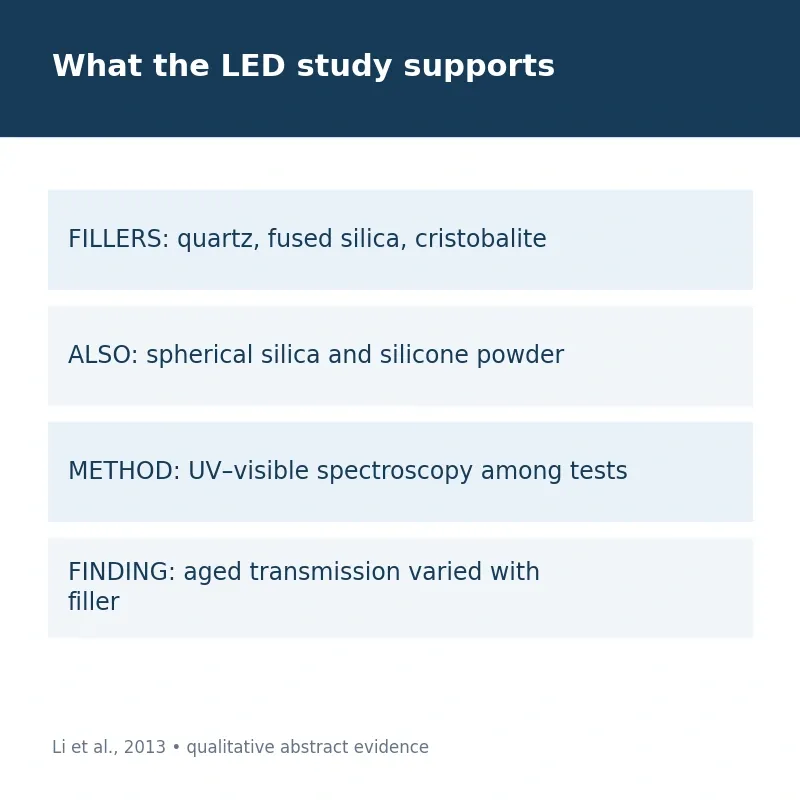
Li and colleagues at Fudan University compared epoxy systems containing quartz, fused silica, cristobalite, spherical silica and spherical silicone powder for LED packaging. Their characterization included UV–visible spectroscopy, thermal analysis and microscopy. The abstract reports that light transmission after UV and thermal aging depended on the filler. It does not establish cristobalite as the best optical filler or provide verified transmission percentages for this article. [1]
Define the optical function before comparing powders
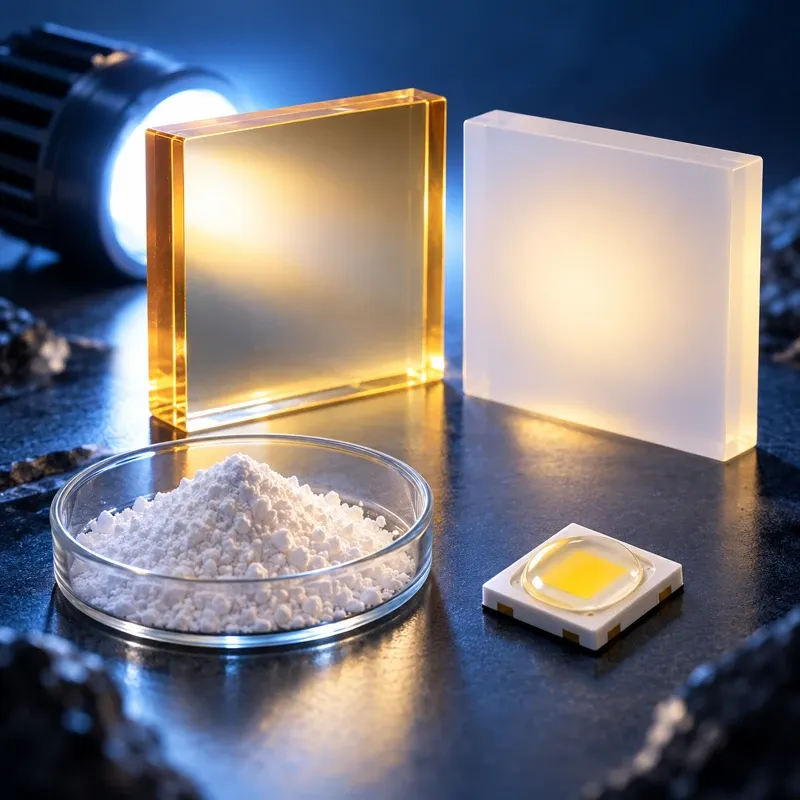
Distinguish transparent encapsulation from an intentionally diffusing layer. The first may prioritize transmission and low haze; the second may accept scattering but need stable light distribution. Specify the emission band, coupon thickness and desired optical role in the inquiry. Powder whiteness is an incoming-material descriptor, while optical performance belongs to the cured formulation.
Build an exposure comparison with an unfilled control
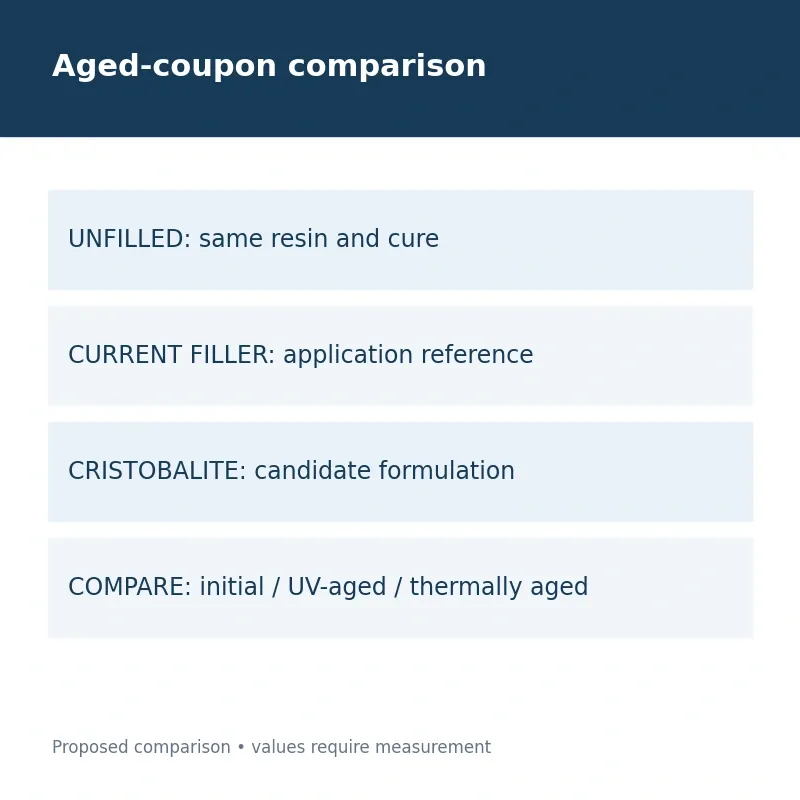
Keep resin chemistry, cure schedule, coupon thickness and surface preparation equivalent. Include unfilled epoxy and the current qualified filler as references. Test the candidate before exposure, after a defined UV exposure, after a defined thermal exposure and, if relevant, after a separate moisture conditioning step. Record the actual dose or duration and temperature. Do not choose arbitrary exposure conditions merely to produce a favorable ranking.
Separate scattering from absorption and specimen defects
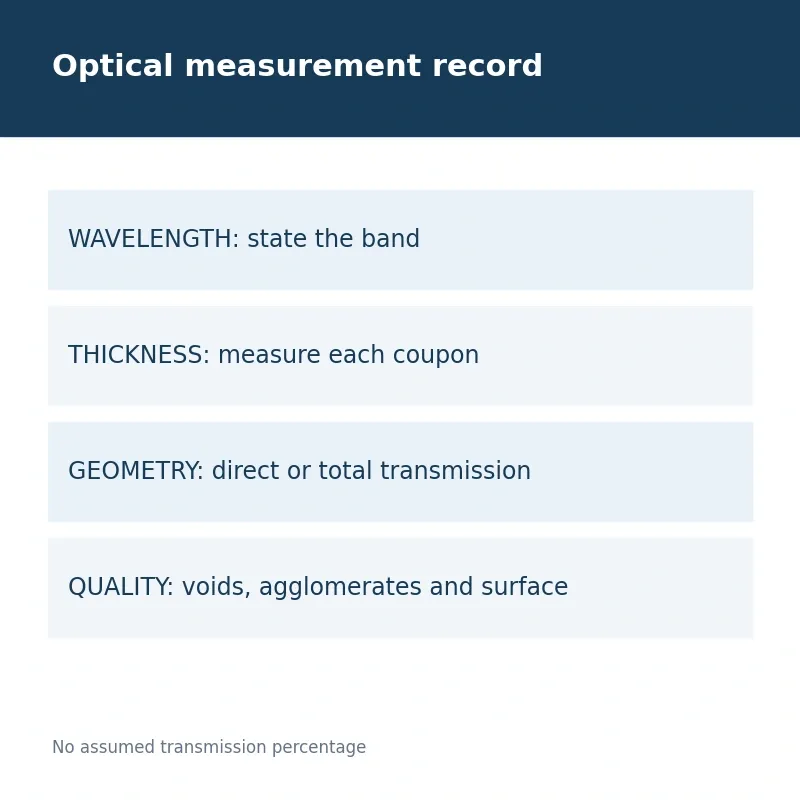
Measure spectral transmission using the documented collection geometry. If haze or diffuse transmission matters, specify the instrument configuration rather than treating every UV–visible reading as the same measurement. Inspect voids, agglomerates and surface defects in parallel. An apparent optical loss may reflect a poor coupon or dispersion problem, so repeatable specimen preparation is part of the comparison.
| Comparison | Record to retain | Decision use |
|---|---|---|
| Initial optics | Wavelength, thickness, transmission geometry | Distinguish transparent and diffusing roles |
| Aged optics | UV exposure, thermal exposure and conditioning | Compare retention using equivalent coupons |
| Defects and interface | Dispersion, bubbles and cured surfaces | Explain a result before changing powder |
Make the tradeoff visible to the buyer
Report optical change together with the relevant thermal expansion, cure behavior and moisture response. A formulation that improves one thermal metric but misses the application’s optical requirement should remain unqualified. Request the candidate’s phase, impurity and surface-treatment information, but do not turn a current TDS into evidence of package reliability. Package-level tests remain a separate acceptance step.
Evidence boundary: Published research is an industry reference, not Changtong test data or a product guarantee. Foundation reference. PubMed abstract and bibliographic record verified; full methods and quantitative optical results were not accessible in this review.
Frequently asked questions
Is high whiteness evidence of transparent epoxy?
No. Whiteness describes the powder measurement; cured optics also depend on the resin, interface, dispersion and specimen.
Does the cited paper publish a universal cristobalite loading?
No verified loading or transmission target is available from the abstract reviewed here. Obtain the full methods before attempting reproduction.
For candidate material discussions, review Changtong cristobalite range. Product availability and application fit require current documentation and customer qualification.
Request an application-specific trial discussion
Provide the resin and cure system, transparent or diffusing function, wavelength band, coupon thickness, intended filler loading and aging acceptance tests. Ask whether an available cristobalite grade is suitable for exploratory screening.
Discuss a documented material trialReference and review scope
[1] Li, T.; Zhang, J.; Wang, H.; Hu, Z.; Yu, Y. High-performance light-emitting diodes encapsulated with silica-filled epoxy materials. ACS Applied Materials & Interfaces 5(18), 8968–8981 (25 September 2013; online 6 September 2013). DOI: 10.1021/am402035r. Peer-reviewed journal article. Foundation reference. PubMed abstract and bibliographic record verified; full methods and quantitative optical results were not accessible in this review. Source checked 9 October 2026. All numeric figures are reference values, with their original material context.
Cover: AI-generated application illustration, not a photograph of Changtong production or an experimental result. Body figures are original evidence summaries and proposed comparison plans.