How Is Crystalline Silica Powder Made? Process & Quality Controls
See how natural quartz becomes crystalline silica powder through selection, crushing, grinding, classification, quality testing and dust-controlled packing.
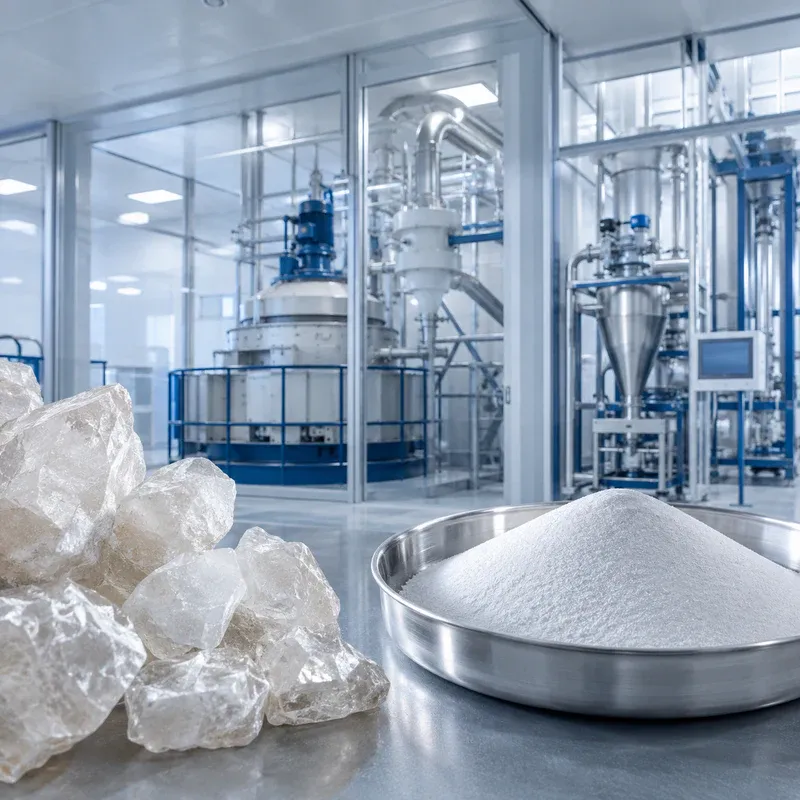
Crystalline silica powder is made by selecting natural quartz, removing surface contamination, reducing the feed size, dry grinding, classifying the particles, testing the finished lot, and packing it under dust-controlled conditions.
The exact mill and classifier settings depend on the target grade, but the buyer-facing control logic is consistent: protect chemistry, control particle-size distribution (PSD), prevent contamination, and preserve lot traceability.
Last updated: · Scope: natural quartz-based crystalline silica powder
Crystalline Silica Powder Manufacturing Process
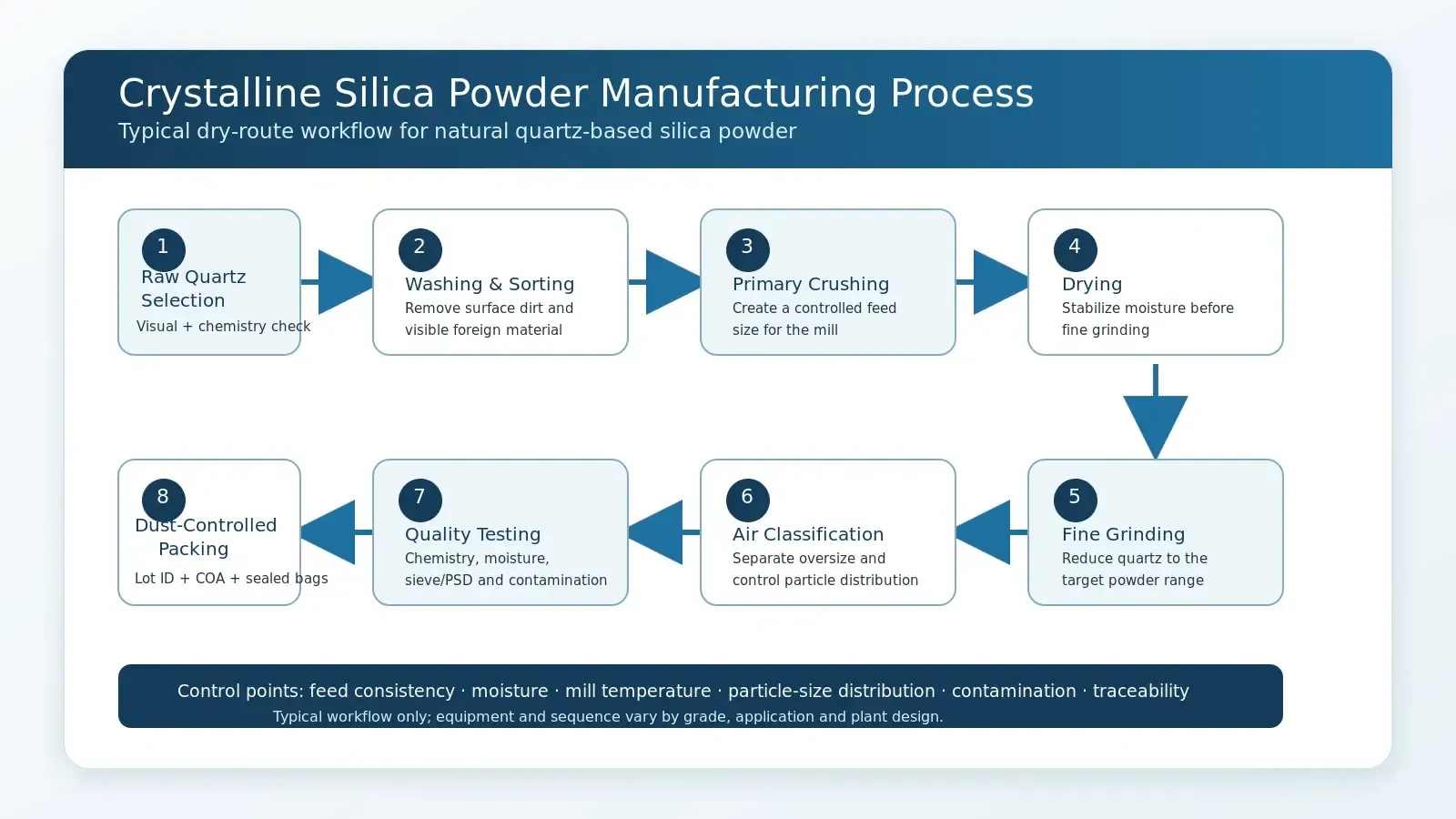
1. Raw Quartz Selection
The process begins with natural quartz feedstock. A processor should define acceptance criteria appropriate to the intended market, such as visible inclusions, color consistency, chemical composition, and lot identity. Stable feed matters because grinding cannot remove mineral impurities already present inside the quartz.
For a new grade, buyers should ask which raw-material characteristics are screened and whether the supplier keeps source or lot records. The useful evidence is a specification and a representative certificate—not an unsupported claim that every deposit behaves identically.
2. Washing and Sorting
Washing can remove soil, clay, and loose surface contamination. Manual or optical sorting may reject visibly discolored or inclusion-rich pieces. If water is used, the material must be dried to a controlled condition before dry milling; otherwise moisture can promote caking, unstable feeding, and classifier drift.
3. Primary Crushing
Jaw, cone, or other primary crushing equipment reduces quartz pieces to a feed size the grinding circuit can accept. A controlled top size helps stabilize throughput and reduces shock loading. Enclosed transfer points and extraction are important because crushing can release respirable crystalline silica dust.
4. Drying and Feed Conditioning
Drying is not automatically required for every source, but it is important when washed or damp feed enters a dry-grinding route. The objective is consistent feed behavior, not simply the highest possible temperature. Moisture should be checked using a defined method and recorded against the lot.
5. Fine Grinding
The conditioned feed is reduced in a fine-grinding mill. Mill type, residence time, energy input, internal temperature, and wear condition all influence the finished PSD. Grinding media and contact surfaces can also introduce contamination, so maintenance and wear monitoring belong in the quality plan.
6. Air Classification and Coarse-Particle Return
An air classifier separates particles according to aerodynamic behavior. Fine product passes to collection while coarse material is rejected or returned to the mill. The classifier cut point, air flow, feed rate, and recycle load should be kept stable. Classification is essential because one mesh label cannot describe the full distribution or guarantee the absence of oversize particles.
7. Quality Testing and Batch Release
Release testing should match the application. Common checks include chemistry, moisture, a defined sieve residue, and/or laser-diffraction PSD. Laser diffraction results should name the dispersion conditions and reporting basis; ISO 13320:2020 provides guidance for laser-diffraction particle-size analysis.
For practical interpretation, see our silica powder mesh size and micron conversion guide. Mesh is useful for a sieve limit, while D10, D50, and D90 describe different points in a particle-size distribution. They are not interchangeable.
8. Dust-Controlled Packing and Traceability
Approved material is collected and packed using sealed transfers, local exhaust ventilation, or other suitable engineering controls. Each package should retain a product name, lot number, net weight, and traceable release status. Packaging selection should protect the powder from moisture and contamination during transport and storage.
Process-Control Matrix for Buyers
The table below is a procurement and audit checklist, not a universal product specification. Acceptance limits must be agreed for the chosen grade and end use.
| Control point | What to monitor | Buyer-facing evidence | Why it matters |
|---|---|---|---|
| Raw quartz | Source/lot, visible inclusions, chemistry | Incoming specification or lot record | Sets the impurity baseline |
| Washed feed | Surface cleanliness and moisture | Defined inspection and moisture method | Reduces contamination and feed instability |
| Crusher discharge | Top size and feed consistency | Crusher or screen control record | Stabilizes the grinding load |
| Grinding circuit | Throughput, temperature, wear condition | Maintenance and process checks | Influences PSD and contamination risk |
| Air classification | Cut point, reject and recycle behavior | In-process PSD or sieve trend | Controls oversize and batch consistency |
| Final quality control | Chemistry, moisture, sieve residue and/or PSD | Lot-specific certificate of analysis | Supports release against agreed limits |
| Packing | Lot ID, seal integrity, net weight | Label and packing inspection | Protects traceability and condition |
How Should Particle Size Be Reported?
Particle-size language should match the decision the buyer needs to make. A coating formulator may care about surface finish and oversize; an electronic-compound buyer may need a much fuller PSD picture. Requesting the test method prevents false equivalence between numbers generated under different conditions.
| Reporting method | Best used for | What it does not prove by itself |
|---|---|---|
| Mesh or sieve residue | Controlling coarse particles at a defined opening | Median size or the complete PSD |
| D10 / D50 / D90 by laser diffraction | Comparing distribution positions between lots | Chemistry, particle shape, or end-use performance |
| Chemistry report | Confirming measured elemental or oxide limits | Particle-size consistency |
| Moisture result | Checking handling and formulation risk | Purity or PSD |
The product specification should state the method, sample preparation, units, and acceptance rule. Comparing only a sales description such as “1250 mesh” can hide meaningful differences in coarse tail, median size, and dispersion behavior.
Where Can Contamination Enter the Process?
Contamination can originate in the quarry feed, wash water, crusher and mill wear, transfer equipment, storage bins, or packaging area. The correct response is a risk-based control plan: define critical contact surfaces, keep incompatible grades separated, clean between campaigns when required, and trend the chemistry or other indicators that matter to the application.
- Is the quoted chemistry a guaranteed limit, a typical value, or one historical result?
- Which particle-size method is used for release?
- How is oversize controlled?
- Can the certificate of analysis be tied to the package lot number?
- What change-control process applies if the raw-material source or grinding circuit changes?
Safety Precautions During Processing and Handling
Grinding and transferring crystalline silica can create respirable dust. The first line of control is engineered containment and dust capture—not personal protective equipment alone. NIOSH describes wet suppression and local exhaust ventilation as standard dust-control approaches for crushing and grinding. The selected method must fit the plant, product route, and local requirements.
For a United States regulatory benchmark, OSHA's respirable crystalline silica standard lists an action level of 25 micrograms per cubic meter and a permissible exposure limit of 50 micrograms per cubic meter, each as an 8-hour time-weighted average. See OSHA's general-industry silica standard and OSHA's crystalline silica overview. Facilities outside the United States must follow their applicable local laws and exposure limits.
| U.S. OSHA benchmark | 8-hour TWA concentration | Practical meaning |
|---|---|---|
| Action level | 25 µg/m³ | Triggers specified exposure-assessment and related duties under the standard |
| Permissible exposure limit | 50 µg/m³ | Maximum regulated 8-hour TWA exposure under the cited OSHA standard |
Operational precautions should include enclosed conveying where feasible, local exhaust at emission points, suitable housekeeping methods, exposure assessment, worker training, and an appropriate respiratory-protection program when engineering and work-practice controls do not reduce exposure sufficiently. Compressed-air dry cleaning can re-suspend fine dust and should not be treated as routine housekeeping.
What Should a Buyer Approve Before Ordering?
Start with the end use, then convert it into measurable requirements. A useful approval package includes:
- application and formulation context;
- target grade and representative sample;
- chemistry limits and test method;
- sieve residue and/or D10, D50, and D90 limits with method;
- moisture limit and packaging format;
- technical data sheet, safety data sheet, and lot-specific certificate of analysis;
- agreed change-control and complaint-traceability expectations.
Application pages provide a useful starting point for defining requirements. Compare crystalline silica powder for electronic packaging, crystalline silica powder for paint and coatings, and crystalline silica powder for silicone rubber. Final suitability still depends on the buyer's formulation, validation, and applicable regulations.
Frequently Asked Questions
Is crystalline silica powder the same as silica fume?
No. Crystalline silica powder in this article is ground natural quartz. Silica fume is an ultrafine by-product collected from silicon or ferrosilicon furnace off-gas. Their origin, morphology, particle size, handling, and typical uses differ.
Why is air classification used after grinding?
Grinding creates a distribution of particle sizes. Air classification separates acceptable fine product from coarse particles and can return the coarse fraction for further grinding. This helps control oversize and improves lot-to-lot PSD consistency.
Does a mesh number equal D50?
No. A mesh designation refers to a sieve opening or sieve-based description, while D50 is the median of a measured distribution. A buyer should ask which test method and acceptance rule produced each value.
Which documents should accompany a production lot?
At minimum, request the agreed specification, current technical and safety data sheets, and a certificate of analysis tied to the shipped lot. Additional documents depend on the application and destination market.
Technical References
Define the Grade Before Comparing Prices
A reliable process protects raw-material consistency, particle-size control, contamination control, and traceability. Send the intended application, test method, chemistry limits, annual quantity, and packaging requirements for a focused grade discussion.
Contact our technical sales team