
Silica–Epoxy Performance Claims: Identify the Control Before Comparing
Read silica–epoxy improvement claims by checking the control, normalized percentages and missing test conditions before comparing surface treatments or grades.
Quality, Testing & Compliance · Technical review ·
Silica–Epoxy Performance Claims: Identify the Control Before Comparing
A percentage improvement needs a denominator. When a silica–epoxy study reports a stronger or more thermally conductive composite, first identify what it was compared with. A comparison against unfilled resin answers a different question from a comparison against an untreated filler at the same loading.
This guide addresses the review of published performance claims. For practical wetting and dispensing selection, use the separate natural-quartz-derived encapsulation screening guide.
One research example, two reported improvements
Wang and colleagues studied spherical silica coated with a metal–polyphenol network and silane coupling agent (MPN–SCA). The publisher abstract reports flexural strength increasing by 45.7% and thermal conductivity by 120.0%, both relative to pure epoxy.
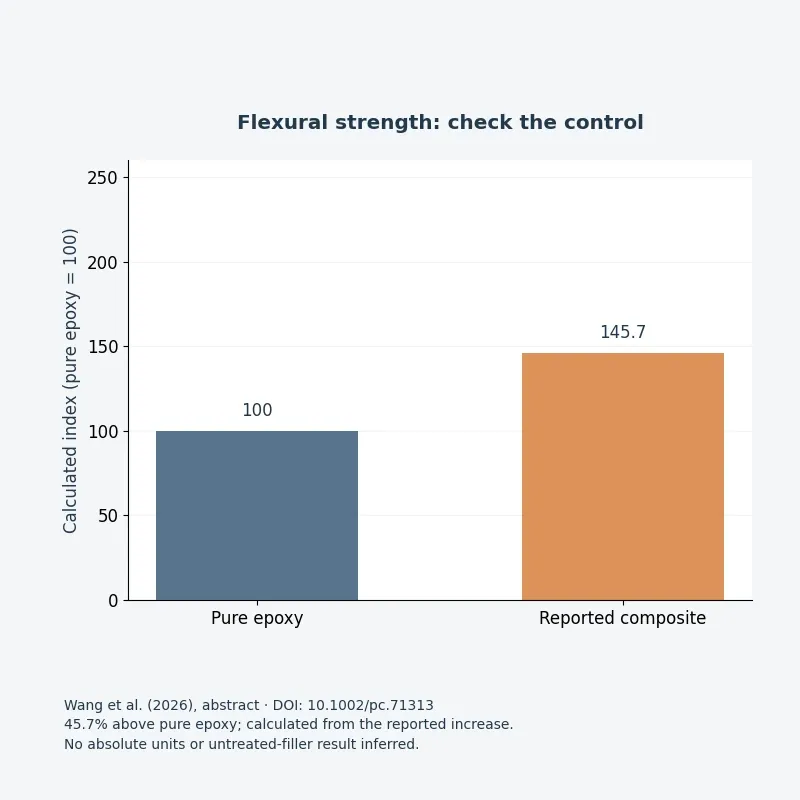
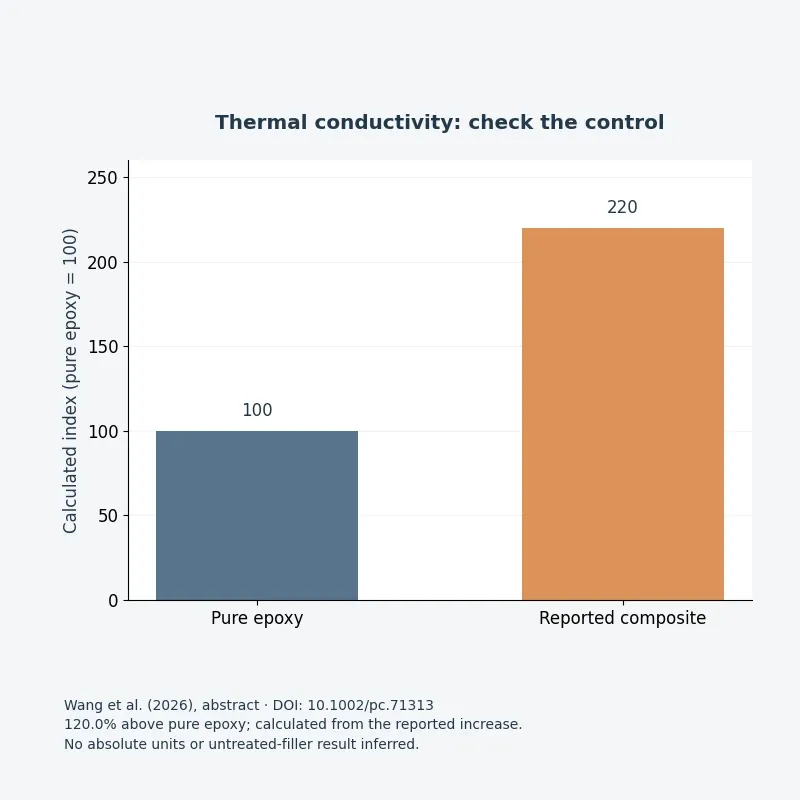
The equation is index = 100 × (1 + increase/100). Each property uses its own pure-epoxy reference. The two indices do not allow flexural strength and thermal conductivity to be compared with each other.
What this accessible evidence can establish
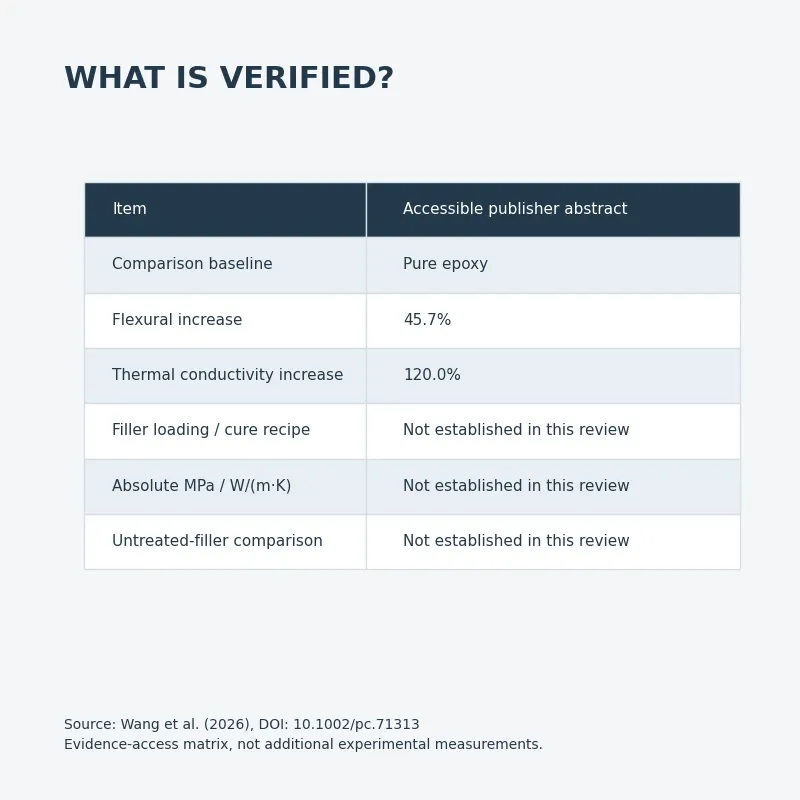
The accessible publisher abstract does not establish the filler loading, cure recipe, absolute MPa or W/(m·K) values, or the untreated-filler result used elsewhere in the full study. No such values are inferred here. The particle description alone also does not establish equivalence to a ground natural-quartz grade.
Separate the questions behind the control
| Comparison | Question it can address | What still needs control |
|---|---|---|
| Filled composite vs unfilled resin | Does the full formulation differ from its resin reference? | Resin and hardener, cure, conditioning, specimen geometry and test method. |
| Treated vs untreated filler | What changes when treatment changes in this filler system? | Filler identity, size distribution, loading basis, moisture, mixing and cure. |
| Candidate vs current production grade | Can this candidate meet the plant acceptance window? | Application recipe, processing history and release tests under the actual production constraints. |
These are proposed trial comparisons. The abstract-level percentages above belong to the first comparison and cannot isolate the contribution of surface treatment alone. A buyer seeking that contribution should request the matched treated/untreated evidence before accepting a treatment-specific claim.
A practical claim-review worksheet
Copy the stated control into the review before copying the headline percentage. Then record whether the result is measured, calculated or inferred. Retain the absolute measurement and units where available, together with the reported uncertainty and number of specimens. If those fields are unavailable, mark them as unverified rather than filling them with plausible numbers.
| Review field | Information to request |
|---|---|
| Material | Mineral phase or production route, particle form, treatment identity and lot. |
| Formulation | Resin/hardener identity, complete recipe, filler loading and whether the basis is mass or volume. |
| Processing | Powder conditioning, mixing history, degassing and cure. |
| Measurement | Method/version, specimen dimensions, test temperature and conditioning. |
| Comparison | Exact control formulation and whether more than one variable changed. |
| Plant decision | Viscosity window, cure behaviour, thermal/electrical requirements and acceptance rules. |
For a thermal-conductivity review, ask whether the same measurement method and specimen state were used for the control and candidate. For flexural results, check that geometry, conditioning and loading procedure are comparable. Do not rank different products using percentages from unmatched studies.
Connect research to a Changtong material inquiry
The cited experimental coating is not a claim about Changtong's treatment process. A buyer evaluating hydrophobic surface-treated silica for encapsulation should request the current product identity and available documentation, then define a trial against its own reference.
Keep ground quartz, fused silica, cristobalite, precipitated silica and fumed silica as separate material families. A similar marketing term or shared SiO₂ chemistry does not establish equal morphology, interface chemistry or cured performance.
Evidence boundary: Published results are industry references, not Changtong measurements or product guarantees.
FAQ
Does a 45.7% increase show that treatment alone improved strength by 45.7%?
No. The reported reference is pure epoxy. A matched untreated-filler comparison is needed to examine a treatment-specific effect.
Can the reported percentages be used in a Changtong product specification?
No. They belong to the cited experimental composite. A product specification requires relevant company or customer measurements under agreed conditions.
What should accompany a supplier's improvement claim?
The control, absolute values and units, material identity, recipe, processing history, test conditions and uncertainty. Request missing fields before interpreting the claim as an application result.
Prepare the comparison before requesting samples
Provide the resin system, current grade, target loading, processing limits, cure conditions and required finished-part tests. State whether the trial is evaluating surface treatment, a supplier change or the full formulation.
Reference and access limit
Wang, D.; Wang, Y.; Liao, C.; Yao, Z.; Xie, N.; Wang, D. “Constructing a Double Crosslinking Structure on Spherical Silica Powder for Enhancement in the Interfacial Adhesion of Epoxy Composite.” Polymer Composites 47(17), 15676–15688. First online June 11, 2026. DOI: 10.1002/pc.71313. Publisher abstract verified; full methods not established in this review. Normalized charts are calculated from the stated percentages. The worksheet and comparison recommendations are editorial guidance.