
Calcined Quartz Powder for Enamel Glazes
Calcined quartz powder for enamel glaze systems on metal and glass. Customer-side comparison reports reviewed 200 and 325 mesh residue, SiO2, Fe2O3 and an 8% glaze addition trial; final grade selection must be confirmed against the frit, substrate and firing process.
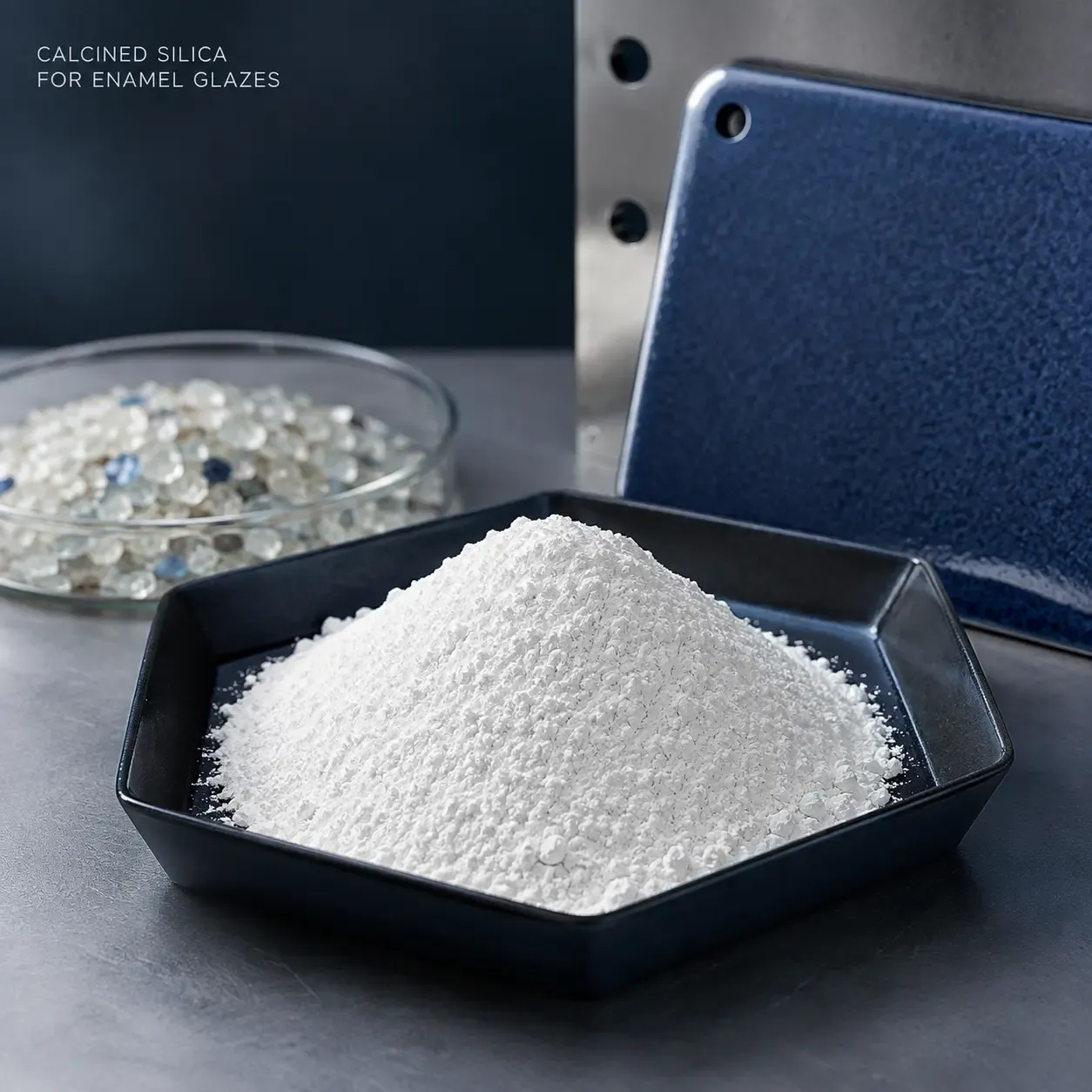
CALCINED SILICA FOR ENAMEL GLAZES
This calcined quartz powder is prepared for enamel glaze formulations applied to metal and glass substrates. It is intended for technical evaluation where mineral chemistry, particle-size distribution, glaze appearance and coating adhesion must be considered together. The suitable grade depends on the glaze frit, substrate, firing schedule, coating thickness and cooling conditions.
Material Role in Enamel Glaze Formulations
Calcined silica can act as a silica-based mineral component in enamel and high-temperature coating systems. Its value is not determined by chemical purity alone. Particle-size distribution, firing response, interaction with the frit and thermal-expansion matching all influence the final glaze layer.
For metal enameling and glass glazing, the formulation should be assessed as a complete system. A powder that performs well in one frit or substrate may require a different grade, addition level or firing schedule in another system.
Reference Properties and Sieve Results
The table below extracts measured results from two customer-side calcined silica comparison reports dated September 13, 2023 and October 30, 2023. Each report compared two samples under its own test set. These are reference results, not a universal product specification.
| Report date | Sample | 200 mesh residue | 325 mesh residue | SiO₂ | Fe₂O₃ |
|---|---|---|---|---|---|
| 2023-09-13 | 1# | 0.16 g/100 g | 9.64 g/100 g | 99.50% | 0.03% |
| 2023-09-13 | 2# | 0.04 g/100 g | 5.80 g/100 g | 99.53% | 0.02% |
| 2023-10-30 | 1# | 0.80 g/100 g | 8.76 g/100 g | 99.43% | 0.07% |
| 2023-10-30 | 2# | 0.96 g/100 g | 8.48 g/100 g | 99.63% | 0.08% |
Sieve values are reported as residue from a 100 g sample. Final grade limits and test methods must be agreed for the customer’s order.

Glaze Addition and Adhesion Comparison
Both comparison reports used the same glaze proportion of 9312E : 9315 : 9316E = 55 : 25 : 20 and added each calcined silica sample at 8%. The reported surface appearance and adhesion were close between the compared samples.
What this evidence supports: under the reported formulation and trial conditions, the two compared calcined silica samples showed similar surface and adhesion behavior. It does not establish a universal result for every frit, substrate, loading or firing schedule.

Thermal Cycling, Corrosion and Wear Evaluation
A silica-containing enamel glaze may be evaluated for resistance to repeated heating and cooling, chemical exposure and surface abrasion. These properties are controlled by the frit chemistry, mineral phase, substrate preparation, coating thickness, firing and cooling conditions.
Thermal Shock
Compare cracking, spalling or adhesion change after the customer’s defined heat-cool cycle.
Chemical Resistance
Evaluate the fired glaze against the acids, alkalis, salts or cleaning agents used in the real service environment.
Surface Wear
Check gloss, surface damage and coating loss under the customer’s defined abrasion method.

Processing and Quality Documentation
Changtong can review the customer’s target mesh, chemistry, glaze system and application method before sampling. Production discussions should connect the selected natural quartz feedstock, calcination condition, grinding, classification, sieve result, chemical analysis and lot identification.
- Confirm the frit composition and substrate before choosing the mineral grade.
- Use the same addition level and mixing route when comparing samples.
- Record sieve residue from a defined sample mass and method.
- Review SiO₂ and Fe₂O₃ on the agreed analytical basis.
- Keep the final coating claim tied to the customer’s thermal, chemical and wear tests.
Application Boundary
This product is a mineral raw material for enamel and high-temperature coating formulation development. The powder alone cannot guarantee corrosion resistance, wear resistance or rapid heat-cool durability. Final performance belongs to the complete glaze, substrate, firing and service system.
Frequently Asked Questions
What evidence is available for enamel glaze evaluation?
Two dated comparison reports recorded sieve residue, SiO₂, Fe₂O₃ and an 8% addition trial. The reports concluded that the compared samples had close surface appearance and adhesion under the stated formulation.
Does a higher SiO₂ value alone determine glaze performance?
No. Particle-size distribution, frit chemistry, substrate, firing schedule and coating thickness must be evaluated together.
Can the same grade be used on metal and glass?
Not automatically. Metal and glass substrates have different surface preparation and thermal-expansion conditions, so each application requires its own trial.
Request a Calcined Silica Glaze Grade
Share your frit composition, substrate, target sieve result, addition level and firing process. Changtong will review the available grade information before sampling.
Request a Quote