Investment Casting Grade Fused Silica: Purity and Properties
Learn how to evaluate fused silica for investment casting using chemistry, particle size, slurry behavior, and firing requirements.
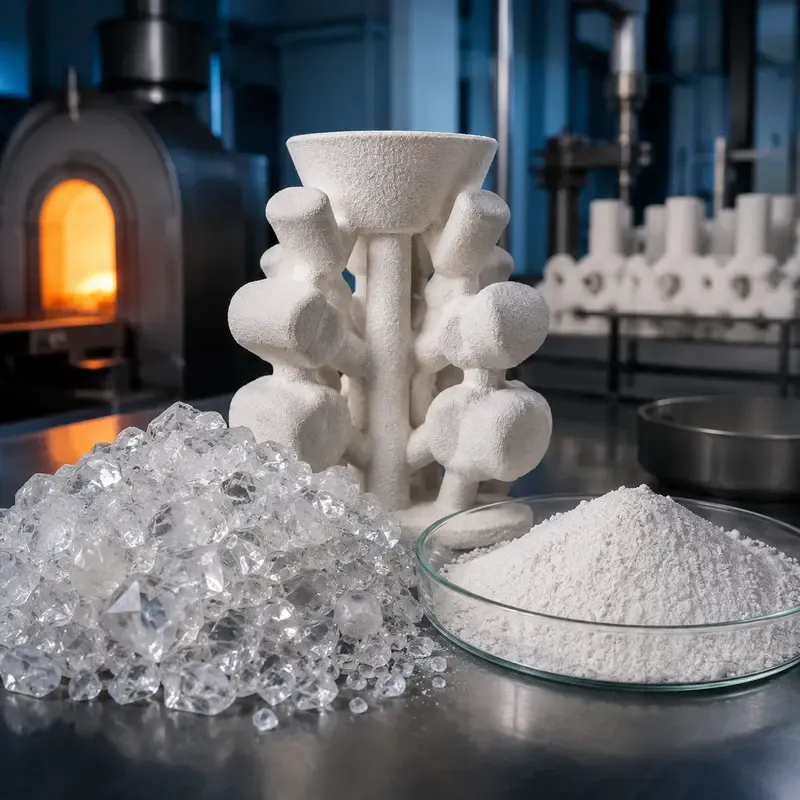
Investment-casting fused silica should be specified as a complete shell-material system, not by purity or mesh alone.
The approval package connects amorphous fused-silica identity, chemistry limits, particle-size distribution, dust condition, slurry compatibility, firing cycle and lot documentation.
Last updated:
Changtong investment-casting grade reference data
The values below are transcribed from a Changtong investment-casting grade sheet dated December 2023. They illustrate the type of evidence a buyer should compare with the current lot COA; they are not a universal guarantee for every fused-silica grade.
| Property | Reference value |
|---|---|
| Structure | Amorphous |
| SiO2 | >99.80% |
| Al2O3 | <200 ppm |
| Fe2O3 | <50 ppm |
| TiO2 | <20 ppm |
| MgO | <40 ppm |
| CaO | <40 ppm |
| Na2O + K2O | <100 ppm |
| Specific gravity | 2.21 g/cm³ |
| Melting point | Approximately 1750°C |
| Hardness | 7 Mohs |
| Thermal expansion | 0.5 × 10⁻⁶ (unit not specified in source sheet) |
| Dust condition | Dust-removal information is included in the source sheet. |
Source: Changtong fused silica investment-casting grade sheet, December 25, 2023. Confirm current revision, test methods and lot-specific results before approval.
What to Check in an Investment-Casting Grade
| Property or control | Why it matters in shell building | What to request |
|---|---|---|
| Material identity | Confirms the grade is amorphous fused silica rather than ground quartz or cristobalite. | Product name, material description, TDS and SDS. |
| SiO2 and trace oxides | Impurities can affect refractoriness, color, reactions and process consistency. | Units, method, limits and lot-specific result on the COA. |
| Particle-size cut | Controls slurry packing, permeability, surface finish and coarse-particle risk. | Sieve basis and/or D10/D50/D90 with method and acceptance rule. |
| Moisture and dust condition | Influences mixing, storage, airborne fines and slurry stability. | Test basis, result, packaging condition and handling guidance. |
| Thermal behavior | Supports dimensional and thermal-shock decisions across the firing cycle. | Relevant grade data and validation in the buyer's shell system. |
| Lot traceability | Allows a shell defect or incoming result to be linked to material history. | Lot ID on bags, COA and shipping documents. |
Purity Is a Limit Set, Not a Marketing Adjective
“High purity” has meaning only when the buyer knows which oxides are controlled, how they are measured and whether the result is typical or guaranteed. An investment-casting specification may need SiO2, Al2O3, Fe2O3, TiO2, alkali and alkaline-earth fields, but the exact limits should be agreed for the shell formulation.
Ask three questions for every number
Is it a typical value or an acceptance limit? Which test method and units apply? Does the result belong to the quoted grade and shipped lot?
Particle Size Affects the Shell, Not Just the Datasheet
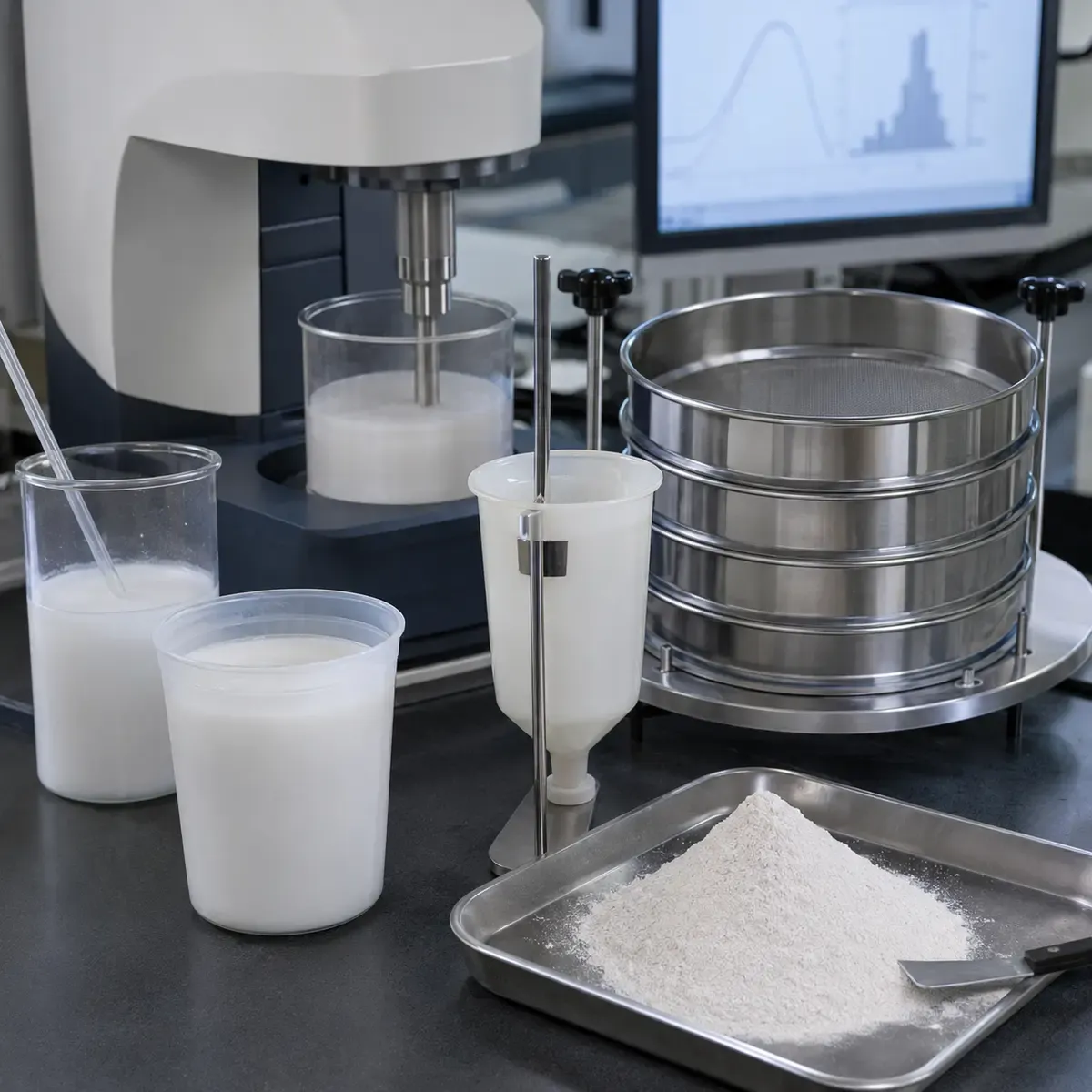
Fine powder can change surface area, wetting and binder demand, while coarse particles affect packing, permeability and surface defects. A mesh name alone does not describe the complete distribution. Read how PSD changes silica-powder behavior and compare the result with the actual slurry process.
| Process observation | Possible material question | Evidence to compare |
|---|---|---|
| Slurry viscosity changes | Has the fine fraction, moisture or agglomeration changed? | PSD, moisture, mixing record and lot history. |
| Surface finish or inclusions change | Has the coarse tail or sieve residue moved? | Retained-percentage data, sieve method and shell inspection. |
| Shell permeability changes | Has the packing structure changed? | PSD and application trial under the same binder conditions. |
Dust Control and Receiving Discipline
Dry fused silica powder still requires an appropriate dust-control plan. Keep bags closed until use, control opening and charging points, avoid dry sweeping, and review the exact SDS. The receiving team should record lot identity before material is transferred into production.
Before Approving a Sample
- Confirm the material family and intended shell application.
- Agree chemistry fields, units, methods and limits.
- Agree sieve and/or PSD reporting, including coarse-tail control.
- Check moisture, packaging and lot traceability.
- Run a controlled shell trial using the buyer's binder and firing cycle.
- Record the approved grade, revision and acceptance criteria.
Frequently Asked Questions
Is higher SiO2 always better?
Not automatically. Purity must be evaluated with particle size, thermal behavior, slurry compatibility, documentation and the actual shell process.
Does 325 mesh define the right investment-casting grade?
No. It describes a nominal sieve designation. The suitable grade also depends on the distribution, chemistry, binder, coating layer and firing cycle.
Why request a lot-specific COA?
It links measured results to the material shipped and supports incoming release, troubleshooting and traceability.
Related Changtong Product
Review Fused Silica Powder for Investment Casting as the product starting point, then confirm chemistry, particle-size distribution, slurry behavior and firing performance in the buyer’s own shell system.
References
- ISO 13320 — Particle size analysis by laser diffraction methods.
- OSHA — Crystalline silica overview, for dry-powder handling context.
Approve the Grade Against Your Shell Process
Send your binder system, firing cycle, target particle-size cut, chemistry limits, package format and required documents for a focused sample discussion.
Contact our technical sales team