Silica Filler Loading: Weight Percent to Volume Percent
Convert silica filler weight loading to volume fraction with constituent density. Check recipe bases and assumptions before comparing resin trials.
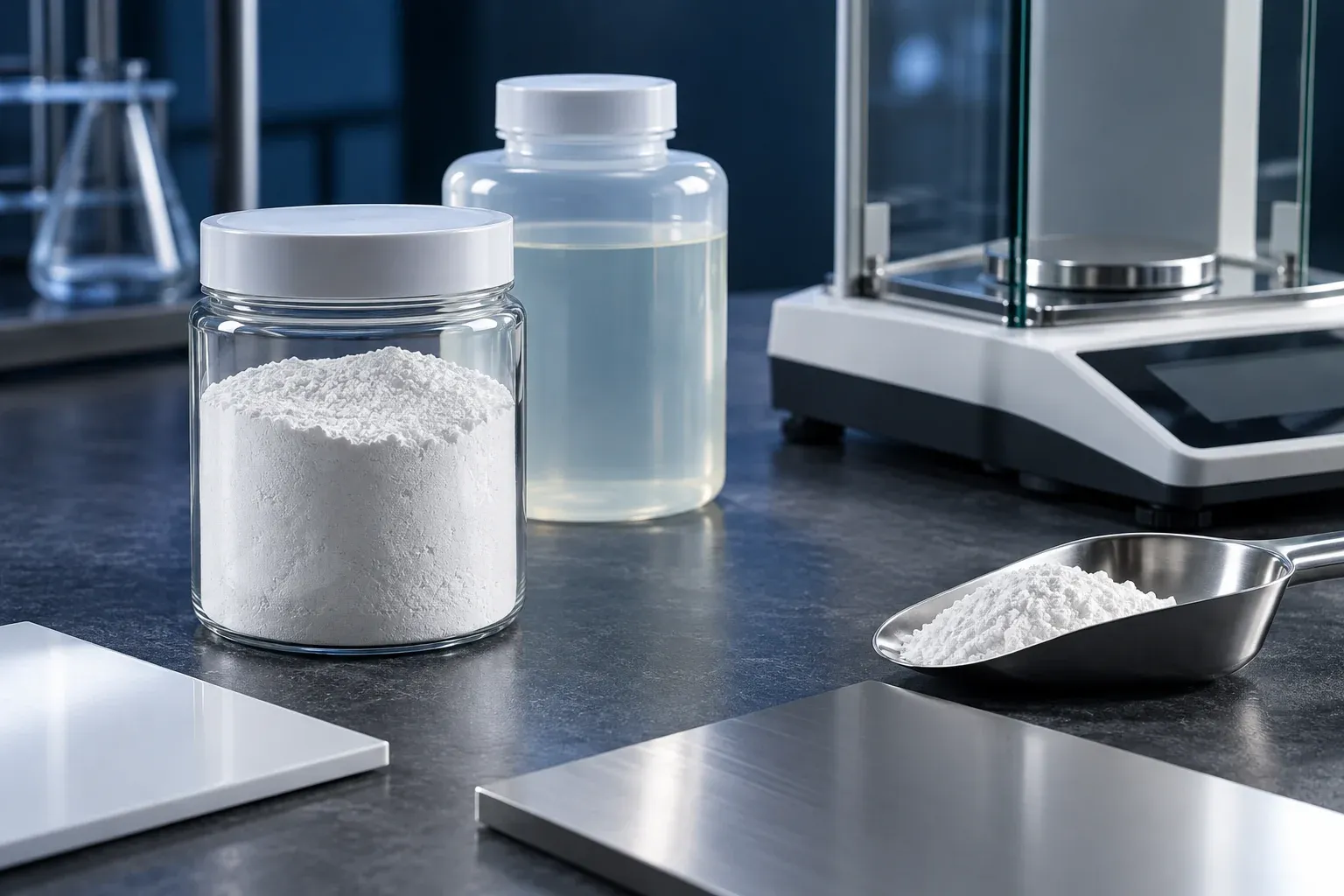
A buyer comparing two resin trials may see the same filler percentage on both worksheets while the mixtures contain different proportions of solid volume. Before interpreting viscosity, mold filling or cost, ask what the percentage measures and which constituents the denominator includes. This article addresses that calculation; it does not prescribe an optimum filler loading.
Name the Recipe Basis Before Converting
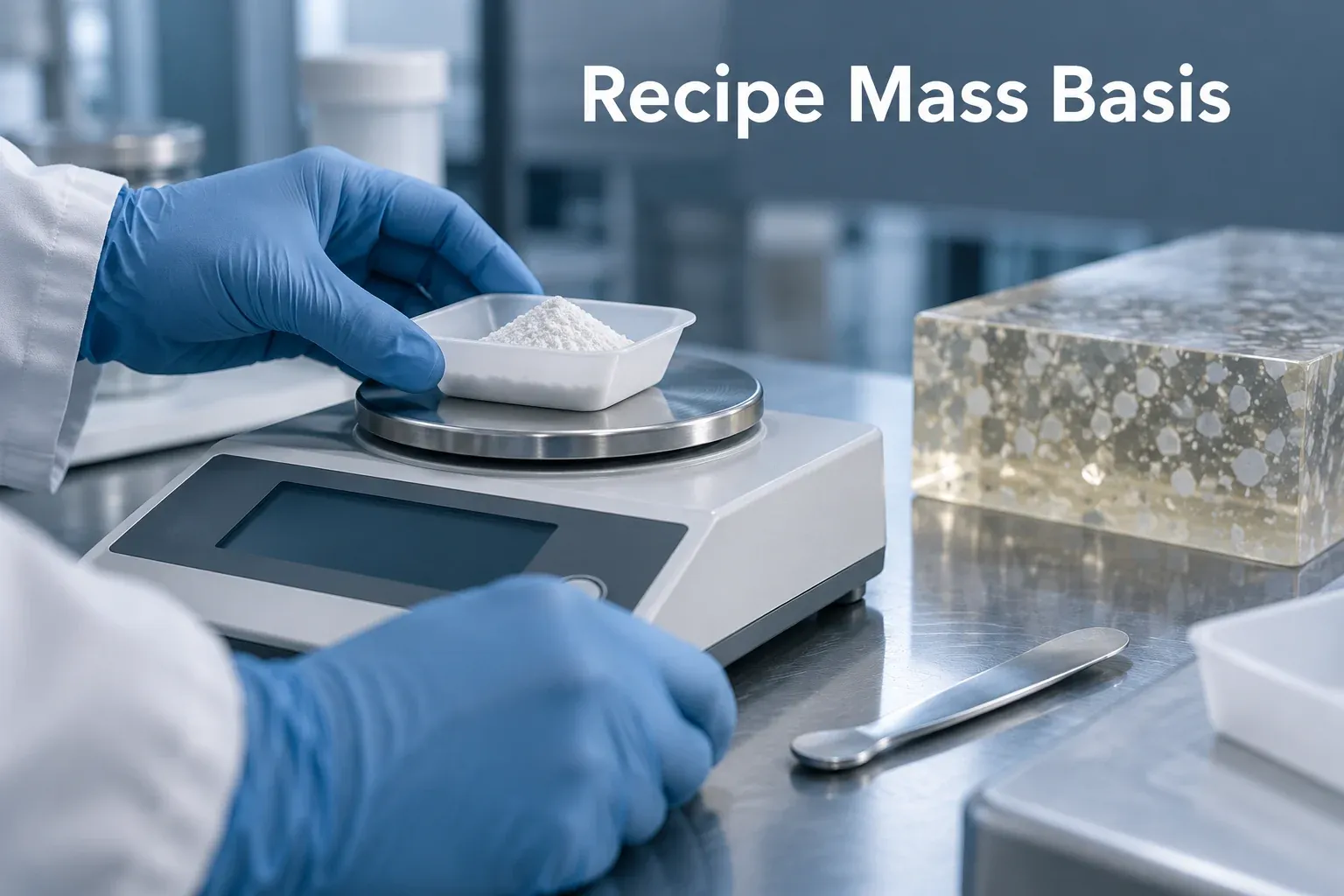
Weight percent, parts per hundred resin and volume percent describe different quantities. A two-component recipe with 60 parts filler per 100 parts resin contains 37.5% filler by mass, not 60%. The calculation changes again if the resin description excludes hardener, solvent or another additive. Preserve the original recipe, then create a second worksheet with a clearly defined total.
| Recipe label | Calculation basis | What to record |
|---|---|---|
| Weight percent | Filler mass / total included mass | List every included constituent. |
| Parts per hundred resin | Filler mass per 100 mass units of specified resin | Say whether hardener belongs to the resin basis. |
| Estimated volume percent | Filler constituent volume / sum of constituent volumes | Use compatible density measurements and a stated temperature. |
Use Constituent Density, Not Loose-Powder Bulk Density
For an additive-volume estimate, calculate each constituent volume as mass divided by density. The filler fraction is (mf/ρf) / Σ(mi/ρi). Use one consistent unit system. Loose-powder bulk or tapped density includes packing voids and answers a container-filling question; it is not a substitute for the constituent density required here.
NIST distinguishes mass fraction, volume fraction and mass density in its SI guidance. Applying those definitions to a formulation requires an explicit modeling assumption: constituent volumes are added without correcting for reaction shrinkage, entrained air or mixing-volume changes. Label the output “estimated ingredient volume fraction” rather than presenting it as a measured cured-part property.
| Constituent | Mass and assumed density | Calculated ingredient volume |
|---|---|---|
| Filler | 60 g; 2.50 g/cm³ | 24.00 cm³ |
| Resin | 40 g; 1.20 g/cm³ | 33.33 cm³ |
| Total / filler share | 100 g; volumes assumed additive | 57.33 cm³ / approximately 41.9 vol% |
For a blend containing two fillers, calculate their volumes separately. Do not average their densities arithmetically and apply that average to the combined mass. Keep rounding until the final result and retain the density source, test basis and lot or grade identity with the worksheet.
Design Two Comparisons When the Question Requires Them
A proposed screening plan can hold mass loading constant to evaluate a production recipe, then run a separate matched-volume comparison to examine a substitution. Neither comparison alone isolates all material effects. Particle shape, size distribution, surface treatment, resin chemistry and mixing history still need to be controlled or reported. Changing several of these together prevents a simple explanation of a viscosity difference.
Record temperature, resin and hardener lots, mixing sequence, mixing time, air-removal process and the chosen response measurement. Separate an initial mixing observation from a cured-component result. If the customer needs shrinkage or thermal-expansion performance, measure the finished formulation instead of deriving a guarantee from a filler percentage.
Put the Calculation in the Sample Request
For an electrical casting application, review the existing fused silica powder for electrical epoxy casting. For a treated mineral filler in a flooring resin, see surface-treated quartz powder for epoxy flooring. These links identify application-specific products; they do not supply density values for this example.
For the separate question of powder packing in a container, use the existing bulk density and tap density test plan.
Questions Buyers Ask
Can 60 wt% be written as 60 vol%?
No. The conversion depends on the density and amount of every constituent included in the basis.
Can a bulk-density result complete the worksheet?
It describes powder packing. Request a constituent-density value and its method before using it for this conversion.
Does a calculated volume fraction predict viscosity?
No. It defines a recipe variable. Measure viscosity using a specified instrument, temperature and shear condition.
What if density evidence is missing?
Keep the conversion provisional and identify the missing input. Do not substitute another silica family’s value.
Technical Reference
NIST Guide to the SI, Chapter 8: quantity definitions. The calculation and screening suggestions above are engineering guidance, not Changtong batch measurements. Reference checked 8 October 2026.
Request a Quote
Provide the complete recipe basis, filler identity, density evidence, target loading and casting or coating process so the sample request can be scoped correctly.
Discuss Your Silica Requirement