Silica Powder RFQ Checklist: What Buyers Should Specify
Use a practical silica powder RFQ checklist covering application, phase, particle size, chemistry, testing, packaging and shipment scope.
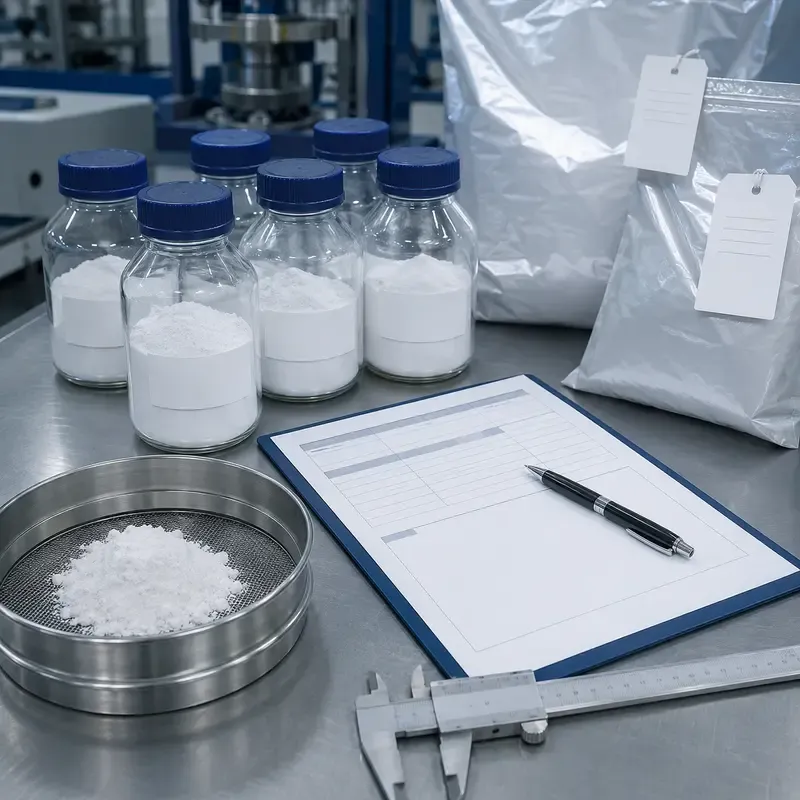
A precise silica powder RFQ makes supplier comparisons faster and prevents a low-price comparison between different materials.
The RFQ should define the application, material identity, particle-size method, chemistry, test evidence, packaging and shipment scope. It is different from a document checklist: the RFQ defines what is being purchased and how it will be accepted.
Last updated:

The Seven Fields Every Silica Powder RFQ Needs
| RFQ field | Buyer should state | Supplier should return |
|---|---|---|
| Application | Resin, coating, rubber, ceramic, refractory, casting or another process. | Recommended material family and relevant trial questions. |
| Material identity | Natural crystalline quartz, fused silica or cristobalite; do not use them as synonyms. | Matching grade name and phase/structure evidence where relevant. |
| Particle size | Mesh/sieve opening, pass or retained percentage, D-values or the required method. | Size distribution in the same method and sample basis. |
| Chemistry | SiO2 target and any impurity or appearance limits. | Current grade reference and lot-specific result where available. |
| Trial method | Loading, binder, mixing, firing, curing or forming conditions. | Sample quantity and a controlled comparison plan. |
| Documents | TDS, SDS, COA, XRD or other defined evidence. | Revision, date, lot scope and document availability. |
| Logistics | Package, quantity, destination, labeling and delivery requirements. | Pack plan and shipment documents. |
Why Mesh Alone Is Not an Acceptance Specification
A mesh designation can describe a sieve opening or a commercial cut, while a particle-size distribution describes the population of particles. Two quotations using the same mesh wording may therefore represent different pass rates or test methods. Buyers should state whether the requirement is a nominal opening, a sieve result, a D10/D50/D90 value or a combined limit.

Reference Values, Typical Values and Release Limits
These three statements must not be mixed. A reference range describes the grade family; a typical value helps a buyer understand expected behavior; a release limit is an acceptance boundary for the agreed lot or shipment. For example, Changtong’s fused silica COA identifies an amorphous structure and reports SiO2 above 99.85% for the named material. That document must be read with its grade, date and lot scope; it is not a universal specification for every silica product.
Frequently Asked Questions
Should the RFQ use mesh or microns?
Use the method that matches the acceptance test. If mesh is used, state the sieve opening and pass/retained basis; if microns are used, state the measurement method and sample condition.
Can one RFQ cover quartz, fused silica and cristobalite?
It can compare them, but the material identity and acceptance evidence must remain separate because their routes and properties differ.
What is the most common RFQ omission?
The most common omission is the application-specific acceptance method. Without it, a supplier can quote a grade but cannot know how the buyer will approve it.
Related Changtong Product
For a practical RFQ baseline, review General-Purpose Crystalline Silica Powder 325 Mesh, then state the required chemistry, particle-size method, packaging and lot-document limits in the inquiry.
References
- ISO 13320 particle-size analysis by laser diffraction.
- Silica powder mesh and micron terminology.
- Changtong material inquiry routing.
Send a Buyer-Ready Silica Powder RFQ
Include the application, material identity, size method, acceptance limits and document scope.
Contact Changtong technical sales